The Edmonton Good Friday Outdoor Way of the Cross brings together members of the Christian social justice community, with a message for everyone, regardless of faith. Once again, this year's event had to be done in video form because of the pandemic, and once again I was happy to help with directing, filming, and editing. In the video, local leaders contribute reflections on environmental justice, homelessness, immigration and systemic racism, Indigenous issues, and more. The video will premiere on YouTube at 10 a.m. this Friday, April 2.
Showing posts with label edmonton. Show all posts
Showing posts with label edmonton. Show all posts
Wednesday, March 31, 2021

Thursday, July 07, 2016
Speaking at a Rally for Palestine
On July 2, I spoke at a rally for Palestine. This time, I was speaking strictly for myself, and not on behalf of any organization. Although it was organized to recognize the controversial Al Quds Day (an observance for Palestine originally started in Iran), I was very impressed that most of the speakers were saying that this was a day to recognize all of the oppressed and occupied peoples of the world, including our own First Nations. While I was specifically asked to speak about BDS and the situation involving access to water in the West Bank, I also acknowledged that I disagree with violence on either side of the conflict in Israel/Palestine. It was a peaceful and respectful gathering, and while I was at first conflicted about speaking there, I was glad afterwards that I did. Below is my speech and a video from the event.
My name is Paula and I am not speaking on behalf of any organization: I am simply speaking as a Jewish citizen who believes that the occupation of Palestine must end. Judaism and Zionism are not the same thing. Despite the efforts of organizations like B'nai B'rith and the Centre for Israel and Jewish Affairs that claim to speak on behalf of the entire Jewish community, there is growing concern among Jewish people in Canada and beyond about the actions of the Israeli government and its human rights atrocities aimed at the Palestinians. I say: not in my name! An end to the occupation is needed for a just and sustainable peace in the Middle East. The occupation, besides being illegal and immoral, does not allow either the Palestinians or the Israelis to live in peace and risks continued escalations of violence against both peoples – not to mention the horrific human rights abuses that the Palestinian people must face every day. Boycotts, Divestments, and Sanctions, better known as BDS, is one tactic to protest the occupation. BDS targets companies and products produced in Israel, particularly in the Occupied Territories. The BDS movement has come under fire this year by the Canadian government, which passed a motion in Parliament to condemn those who support BDS and reject it. As a peace activist, I fear that such a motion is a slippery slope to delegitimize people and organizations for their political beliefs. BDS is a peaceful, non-violent means of protest – it is, in fact, simply a conscious act of refraining from something - that takes both a political and moral stand. For the government to condemn people for their beliefs is overstepping boundaries in a way that has no place in a democratic society. As a Jewish person, my spiritual practise includes tikkun 'olam, which means healing or repairing the world. Our faith and history teach us that we must stand up in the face of injustice. When it comes to the plight of the Palestinian people, the word “injustice” barely begins to cover it. The latest outrage concerns allegations that the main supply of water to Palestinian towns and cities such as Jenin, several Nablus villages, and surrounding areas was manipulated during the holy month of Ramadan. The executive director of a Palestinian NGO focused on water and sanitation issues reported to Al Jazeera that some areas had not received water for more than 40 days, with families having to live on two, three, or 10 litres per capita per day. Water is a basic human right. According to the UN, 7.5 litres per person, per day is the minimum requirement for most people, but areas of Palestine reach more than 35 degrees Celcius in temperature, so much more is needed. As also reported on Al Jazeera, Israelis, including settlers, consume five times more water than Palestinians in the West Bank: 350 litres per person per day in Israel compared with 60 litres per day in the West Bank. According to Amnesty International, almost 200,00 Palestinians in the West Bank do not have access to running water, and require permission before collecting it themselves. Getting back to my stance as a Jewish person of conscience, I have been accused of being a “self-hating Jew” and someone even once asked me why I hate Israel. For the record, I don't hate Israel – I have never said that in any discourse, publicly or otherwise. For the record, any senseless deaths of anyone saddens me, and I don't believe that acts of violence accomplish anything except beget more violence. Ending the occupation will save lives, both Israeli and Palestinian, and is the only path leading to a just and lasting peace.
My name is Paula and I am not speaking on behalf of any organization: I am simply speaking as a Jewish citizen who believes that the occupation of Palestine must end. Judaism and Zionism are not the same thing. Despite the efforts of organizations like B'nai B'rith and the Centre for Israel and Jewish Affairs that claim to speak on behalf of the entire Jewish community, there is growing concern among Jewish people in Canada and beyond about the actions of the Israeli government and its human rights atrocities aimed at the Palestinians. I say: not in my name! An end to the occupation is needed for a just and sustainable peace in the Middle East. The occupation, besides being illegal and immoral, does not allow either the Palestinians or the Israelis to live in peace and risks continued escalations of violence against both peoples – not to mention the horrific human rights abuses that the Palestinian people must face every day. Boycotts, Divestments, and Sanctions, better known as BDS, is one tactic to protest the occupation. BDS targets companies and products produced in Israel, particularly in the Occupied Territories. The BDS movement has come under fire this year by the Canadian government, which passed a motion in Parliament to condemn those who support BDS and reject it. As a peace activist, I fear that such a motion is a slippery slope to delegitimize people and organizations for their political beliefs. BDS is a peaceful, non-violent means of protest – it is, in fact, simply a conscious act of refraining from something - that takes both a political and moral stand. For the government to condemn people for their beliefs is overstepping boundaries in a way that has no place in a democratic society. As a Jewish person, my spiritual practise includes tikkun 'olam, which means healing or repairing the world. Our faith and history teach us that we must stand up in the face of injustice. When it comes to the plight of the Palestinian people, the word “injustice” barely begins to cover it. The latest outrage concerns allegations that the main supply of water to Palestinian towns and cities such as Jenin, several Nablus villages, and surrounding areas was manipulated during the holy month of Ramadan. The executive director of a Palestinian NGO focused on water and sanitation issues reported to Al Jazeera that some areas had not received water for more than 40 days, with families having to live on two, three, or 10 litres per capita per day. Water is a basic human right. According to the UN, 7.5 litres per person, per day is the minimum requirement for most people, but areas of Palestine reach more than 35 degrees Celcius in temperature, so much more is needed. As also reported on Al Jazeera, Israelis, including settlers, consume five times more water than Palestinians in the West Bank: 350 litres per person per day in Israel compared with 60 litres per day in the West Bank. According to Amnesty International, almost 200,00 Palestinians in the West Bank do not have access to running water, and require permission before collecting it themselves. Getting back to my stance as a Jewish person of conscience, I have been accused of being a “self-hating Jew” and someone even once asked me why I hate Israel. For the record, I don't hate Israel – I have never said that in any discourse, publicly or otherwise. For the record, any senseless deaths of anyone saddens me, and I don't believe that acts of violence accomplish anything except beget more violence. Ending the occupation will save lives, both Israeli and Palestinian, and is the only path leading to a just and lasting peace.
Thursday, July 10, 2014
Speaking Out Again on the Middle East
On Tuesday evening, July 8, I spoke at an emergency rally concerning the situation in Israel and Palestine, on behalf of the Edmonton Coalition Against War and Racism and Independent Jewish Voices. The rally was a call for peace and a protest against the collective punishment of Gaza in retribution for the tragic deaths of three Israeli teenagers last week. Below is the text of my speech, as well as a video of me speaking.
The Edmonton Coalition Against War and Racism condemns the collective punishment and violence against the Palestinian people by the government of Israel. We believe in the right to self-determination for all people without imperialistic interference, and this includes Palestine. We call on everyone to work for an anti-war government in Canada. There can be no solution without recognizing the rights of the Palestinian people. I am also the Alberta representative on the National Steering Committee of Independent Jewish Voices (IJV). Independent Jewish Voices is a national human rights organization whose mandate is to promote a just resolution to the dispute in Israel and Palestine through the application of international law and respect for the human rights of all parties. IJV is made up of Jewish people (and non-Jewish supporters) from across the country. We come from different walks of life, levels of religious observance, professions, and ages, but the one thing we have in common is that we believe that the occupation of Palestine is wrong and must stop. Politically, we provide an alternative to organizations such as B'nai B'rith and the Canadian Jewish Political Affairs Committee which claim to speak on behalf of all Canadian Jews. They don't. In light of the recent tragedies we are hearing more Jewish voices calling out for an end to the occupation, even within Israel itself. To quote Gideon Levy, who is a Jewish writer for the major Israeli newspaper Ha'Aretz: “In the Jewish state, there is no remnant of the biblical injunction to treat the minority or the stranger with justice. There are no more Jews left who marched with Martin Luther King or who sat in jail with Nelson Mandela. The Jewish state, which Israel insists the Palestinians recognize, must first recognize itself. At the end of the day, at the end of a terrible week, it seems that a Jewish state means a racist, nationalistic state, meant for Jews only.” My heart breaks at the recent, senseless, tragic murders of the three Israeli teenagers. It also breaks at the Palestinians who have been murdered by Israel in retribution, including a 16 year old who was burned while he was still alive. IJV takes the stand that all of these heinous crimes are the inevitable result of Israel’s brutal and illegal occupation of Palestine. In a press release that IJV issued last week, our spokesperson Tyler Levitan did not mince words. “Make no mistake, the burden of responsibility rests with the occupying power – Israel. The blood of these youth is also on Canada’s hands, as Canada’s government unconditionally supports Israel’s violent military occupation of the West Bank and siege of Gaza, which repeatedly fuels more violence,” he said. The bottom line is that the occupation is not only illegal and immoral, but bad for the futures of both Israelis and Palestinians. It is causing misery and death for both peoples, and they deserve better. It is time for Canada's government to stop supporting the policies of the Israeli government and to take a stand against the brutal occupation of the Palestinians. It is time for the Jewish community as a whole to open its eyes and accept that just because we have been oppressed does not give us the right to become or to support the oppression. We must stand up for the rights of all, including the Palestinians. Our religion and our history demands it. Finally, Canadians must put an end to the lawlessness of the Harper dictatorship which claims to stand for law and order but acts in defiance of international law - giving its support and even directly participating in illegal occupations, war crimes, collective punishment, use of banned weapons, and many other heinous crimes against the Palestinian people and humanity. Shalom.
The Edmonton Coalition Against War and Racism condemns the collective punishment and violence against the Palestinian people by the government of Israel. We believe in the right to self-determination for all people without imperialistic interference, and this includes Palestine. We call on everyone to work for an anti-war government in Canada. There can be no solution without recognizing the rights of the Palestinian people. I am also the Alberta representative on the National Steering Committee of Independent Jewish Voices (IJV). Independent Jewish Voices is a national human rights organization whose mandate is to promote a just resolution to the dispute in Israel and Palestine through the application of international law and respect for the human rights of all parties. IJV is made up of Jewish people (and non-Jewish supporters) from across the country. We come from different walks of life, levels of religious observance, professions, and ages, but the one thing we have in common is that we believe that the occupation of Palestine is wrong and must stop. Politically, we provide an alternative to organizations such as B'nai B'rith and the Canadian Jewish Political Affairs Committee which claim to speak on behalf of all Canadian Jews. They don't. In light of the recent tragedies we are hearing more Jewish voices calling out for an end to the occupation, even within Israel itself. To quote Gideon Levy, who is a Jewish writer for the major Israeli newspaper Ha'Aretz: “In the Jewish state, there is no remnant of the biblical injunction to treat the minority or the stranger with justice. There are no more Jews left who marched with Martin Luther King or who sat in jail with Nelson Mandela. The Jewish state, which Israel insists the Palestinians recognize, must first recognize itself. At the end of the day, at the end of a terrible week, it seems that a Jewish state means a racist, nationalistic state, meant for Jews only.” My heart breaks at the recent, senseless, tragic murders of the three Israeli teenagers. It also breaks at the Palestinians who have been murdered by Israel in retribution, including a 16 year old who was burned while he was still alive. IJV takes the stand that all of these heinous crimes are the inevitable result of Israel’s brutal and illegal occupation of Palestine. In a press release that IJV issued last week, our spokesperson Tyler Levitan did not mince words. “Make no mistake, the burden of responsibility rests with the occupying power – Israel. The blood of these youth is also on Canada’s hands, as Canada’s government unconditionally supports Israel’s violent military occupation of the West Bank and siege of Gaza, which repeatedly fuels more violence,” he said. The bottom line is that the occupation is not only illegal and immoral, but bad for the futures of both Israelis and Palestinians. It is causing misery and death for both peoples, and they deserve better. It is time for Canada's government to stop supporting the policies of the Israeli government and to take a stand against the brutal occupation of the Palestinians. It is time for the Jewish community as a whole to open its eyes and accept that just because we have been oppressed does not give us the right to become or to support the oppression. We must stand up for the rights of all, including the Palestinians. Our religion and our history demands it. Finally, Canadians must put an end to the lawlessness of the Harper dictatorship which claims to stand for law and order but acts in defiance of international law - giving its support and even directly participating in illegal occupations, war crimes, collective punishment, use of banned weapons, and many other heinous crimes against the Palestinian people and humanity. Shalom.
Sunday, May 25, 2014
Poverty in the City: It's Not the Agencies - It's All of Us
I spent the day on Whyte Avenue on Saturday. I was accosted by a panhandler almost as soon as I got out of my cab. Throughout the day I witnessed homeless and transient people pushing full shopping carts, sitting on the sidewalk, staggering around drunk, and swearing loudly. I saw the evidence of their lives scattered throughout the area: litter, broken bottles, stains on the concrete from all kinds of bodily fluids (granted - some of this may be the result of bar hoppers needing to rid themselves of their last few drinks). Yet this is still considered a desirable area of Edmonton to live, work, and hang out.
The next day, I took a walk through Chinatown, and saw pretty much the same things. However, in this case, many have come to expect problems in this area of the city with homelessness, addictions, and mental illness. Many of the city's agencies that serve this population are nearby. Some people blame the concentration of agencies for the problems. Some consider the inner city a much less desirable area to live, work, or hang out because of all of the social issues there. It is just an accepted fact that in that part of the city, excrement occurs (often literally).
However, as I observed this past weekend, these problems are everywhere throughout the city. And where there is an agency, there is perceived blame. The Neighbour Centre is near Old Strathcona and according to a friend of mine who used to work there, the actual neighbours of the centre are none too pleased. Not from where I grew up, in the Jasper Gates area, the Jasper Place Health and Wellness Centre (and its associated social housing) has garnered many of the same complaints I have heard levied against places like the Boyle McCauley Health Centre. Heck, the first place I ever saw a man urinate outside was in the parking lot of the Jasper Gates shopping centre.
The question is: what can be done about poverty and its resulting social disorder? There is no easy answer to such a complicated question. Yet it is so easy to point out the problems and complain about them - I myself am guilty of such behaviour - but not as simple to try to think of solutions. I am an activist with political leanings that are left of centre. This world view has shaped my perspective on social issues in general, and specific ones such as poverty and housing.
In my mind, the first question that needs to be asked is why there is poverty and homelessness in such an affluent city in the first place? All poverty, everywhere in the city - it is not okay to just accept the unacceptable in a lower income, rougher area. The answer, my friend, is systemic and will require systemic changes. Basically, we have a political and economic system (the two are inextricably interconnected) that is based on greed. The rich are getting richer and the middle class is being eroded.
So, the answer is not throwing more money at the problem. It's not further concentrating essential services and agencies in parts of the city that are already saturated. And it certainly is not gentrification. We - all of us - need to change the way we look at issues such as material wealth, consumerism, and the way we make a living. We need to question who we vote for and why, and try to effect change on a grassroots level.
As an activist, I get very angry at seeing the inequalities in our society. But anger will only take someone so far and no more. Anger needs to lead to action. Otherwise, it just leads to ulcers and depression. Maybe I am being overly idealistic here, but if idealism can be a motivating force (along with anger!), then maybe that is the first step towards what we need to do.
Wednesday, June 19, 2013
Citizen Edmonton

Probably getting the word out there about events and especially getting the media involved. From a personal perspective, I think that my politics often overshadow my persona, in that people who have never met me in real life and only know me from the photos and videos I post, from promoting events, or from standpoints I have taken, expect me to be some kind of crazy, left-wing, granola crunching, tree hugging, hippy. Which is why being invited to an event like Citizen Edmonton was so important to me - because I got a chance to reach out to a different crowd and perhaps dispel some myths about activists. Here are some questions that really stood out for me. What are some of the issues that tend to attract protests and protesters?
It really depends what current events are hot topics. We've seen recently lots of protests concerning education, cuts to programs for PDD, and the huge March Against Monsanto. People are more likely to attend a protest if they feel a personal connection to the issue, which is why we often see larger attendance at rallies that deal with civic or provincial issues. So, a way to attract people to events is to try to highlight that connection; how an issue affects all of us, even if it is something having to do with Canada's foreign policy or something else seemingly more detached from our daily lives. How can people protect themselves legally at protests?
Carry a phone that can record photos and video, and be prepared to use it if you see something going on that does not seem right. Be aware of your surroundings, and if someone else appears to be acting strangely or being an instigator, disassociate from them immediately. How can you tell if you are being effective through your efforts?
This can be measured in different ways. Attendance is one. Getting the message out there is another. Protests seek to attract attention about a topic, so whatever way you can get the message out increases that efficacy. And this is a large reason why I started Radical Citizen Media: to make sure that when protests happen, that they are documented properly so that people can see for themselves what was said, how many people were there, and what the issue is really about - all things that the mainstream media often do not cover in depth. What role does the media play? How do you connect with the media?
Press releases are often sent out to media outlets prior to a protest, at least in my experience. What happens next is often out of our hands. Mainstream media is often run by advertising, so hands are tied when a protest involves a sponsor or advertiser. Independent media, like Radical Citizen Media, does not have those constraints, but we also don't have the resources, so it can be a Catch-22. However, we do have an effect on the media, because in situations where, for example, attendance is under-reported, we use our photos and videos to show what actually happened, and this has resulted in retractions. What are the three biggest obstacles in the activist community?
Communication, or the lack thereof - misunderstandings and other inter-personal situations often result in certain groups of people or organizations not speaking to each other or preventing them from working together effectively.
Organizers being disorganized - making sure people know what they are responsible for doing and seeing that it gets done.
Becoming activist elitists - only hanging out with other activist, only going to activist events, cutting ourselves off from the rest of society where we seek to effect change: this is very counter-productive. I am going to whip out my chequebook and write three cheques. Where are the biggest needs?
I could not answer that effectively without knowing the financial situation of ever non-profit in Edmonton, but I would encourage someone to contribute to whatever organizations they are passionate about rather than just seeking out non-profits based on financial need. That being said, there are also many organizations that have needs beyond money - inner city organizations like Bissell Centre or The Mustard Seed often need practical items. I was far too busy to take photos or video at Citizen Edmonton, but several professionals were there to take care of that. I'll post them when they become available. On a final note, interVivos made an announcement that it now has a forest in Manning, Alberta. The trees will be named for the people who speak at event, and the seven of us who were panelists last night are the first seven seedlings. I hope to get out there one day to visit my tree! Maybe I will even hug it.
Monday, November 19, 2012
Emergency Gaza Rally - A Jewish Perspective
An emergency rally for the people of Gaza was held in Edmonton on November 17. Organized by the Edmonton Coalition Against War & Racism (ECAWAR) and the Palestine Solidarity Network, the rally joined others that have been taking place around the world over the past few days in light of Israeli aggression against Gaza. What else can the world expect - there is an election coming up in Israel, and Netanyahu has to play the big man now, responding with force far times greater than the rockets being fired into Israel. While I certainly don't agree with aggression on either side of this conflict, it is hard for me to understand the concept of Israel's argument of self-defense. When a people who are under an illegal and inhumane blockade rise up in arms against those who put them in that situation, the argument that Israel is defending itself it almost ridiculous.
I was asked to speak on behalf of Independent Jewish Voices as well as sing. Unfortunately, the temperatures were a bit cold to play the guitar outside, so I recited the lyrics to one of my songs about the Middle East conflict called "The Side of Peace." Below is my speech and poem. For a full set of photos from the event, click here. For videos, click here.
Independent Jewish Voices has chapters in eight cities across the country and consists of Canadian Jews from diverse backgrounds who share a strong commitment to social justice and universal human rights, to reclaim the tradition of Jewish support for universal freedoms, human rights, and social justice. In fact, we believe that the broad spectrum of opinion amongst the Jewish population of this country is not reflected by institutions that claim to represent Jewish communities as a whole. We believe that individuals and groups should feel free to express their views on any issue of public concern without incurring accusations of disloyalty and we are compelled to speak out because of the lessons we have learned from our own history. As such, Independent Jewish Voices condemns Israel’s latest attack on the Palestinians trapped in Gaza by Israel’s illegal blockade. Israel has euphemistically dubbed the operation “Pillar of Defense” (alternately Pillar of Cloud). However, as one IJV Steering Committee member, Dylan Penner, has pointed out, “Israel’s latest attack on Gaza is not a ‘Pillar of Defense.’ It’s a Pillar of War Crimes, which we have a moral obligation to oppose.” He also goes on to say that, “This latest atrocity is compounded by the fact that, thanks to Israel’s illegal and inhumane blockade, for the people who live in Gaza there is no escape.” Just look at recent history - four years ago, Israel launched its “Operation Cast Lead” on the Gaza Strip. Over 1400 Palestinians were killed — over a third of whom were innocent women and children. Israel claimed moral righteousness while committing this massacre, but the United Nations later found that Israel committed war crimes and possible crimes against humanity and that “the assault was designed to humiliate and terrorize a civilian population.” Amnesty International concluded that Israel’s aggression amounted to “22 days of death and destruction.” I am a Canadian-born Jewish woman who believes strongly in the Jewish value of tikkun olam, which means healing or repairing the world. When I see the devastating and inhumane and illegal treatment of the Palestinian people by a government and military supposedly representing my religion and culture, it is with a deeply broken heart. The actions of the Israeli government and military is antithetical to the true values of Judaism which include compassion, reason, and social justice. It is for these reasons that I cannot support such actions. I find it horribly offensive for any of the brutality in Palestine to be attributed to being in my name – it is not in my name. It tarnishes my religion and culture. I encourage other Jewish people to really look at the situation objectively and not through the idealized notions of Israel with which many of us were raised. To blindly support a nation and its government because of misplaced nationalistic fervour or perceived ownership based on selective Biblical interpretation is illogical. Zionism and Judaism are not the same thing. Historically Zionism was opposed by almost all organized branches of Judaism. Even today, not all Jews are Zionists. Actually, Zionism’s strongest cheerleaders today are Christians. So, accusations that anti-Zionism equals anti-Semitism are very much unfounded and merely a way of stirring up trouble towards those people who are critics of Israel. In fact, there are many Jewish voices from within Israel and around the world who are opposed to the Israeli colonial settlement policy in the Occupied Territories and those voices are getting stronger. Thank you. The Side of Peace I’ve marched in Gaza rallies
And sung for Arab crowds
Though some of my relations
Think I should not be allowed.
I’m asked why do I do it?
Or if I’m scared at the very least;
The only answer that I have,
Is I’m on the side of Peace. I always say I’m Jewish,
It’s part of who I am.
So is speaking out
For human rights as best I can.
This conflict is immoral
I want it all to cease
And that is why I take a stand
On the side of Peace. When innocent civilians
Are killed day after day
By military massacres
I have the right to say
Collective punishment is wrong
As the death tolls increase.
The only way to save lives
Is on the side of Peace. Unlike so many others
I can’t support a nation
When it’s so horrific towards
Part of the population
Yes, the leaders are not innocent
But the children are, indeed
So are all the others who
Are on the side of Peace. It’s easy to be silent
Or toe the party line
Complicity is for cowards
Who are part of the crime.
I will never be accused
Of groveling on my knees
I stand with my conscience
On the side of Peace. © 2009 Paula E. Kirman
Independent Jewish Voices has chapters in eight cities across the country and consists of Canadian Jews from diverse backgrounds who share a strong commitment to social justice and universal human rights, to reclaim the tradition of Jewish support for universal freedoms, human rights, and social justice. In fact, we believe that the broad spectrum of opinion amongst the Jewish population of this country is not reflected by institutions that claim to represent Jewish communities as a whole. We believe that individuals and groups should feel free to express their views on any issue of public concern without incurring accusations of disloyalty and we are compelled to speak out because of the lessons we have learned from our own history. As such, Independent Jewish Voices condemns Israel’s latest attack on the Palestinians trapped in Gaza by Israel’s illegal blockade. Israel has euphemistically dubbed the operation “Pillar of Defense” (alternately Pillar of Cloud). However, as one IJV Steering Committee member, Dylan Penner, has pointed out, “Israel’s latest attack on Gaza is not a ‘Pillar of Defense.’ It’s a Pillar of War Crimes, which we have a moral obligation to oppose.” He also goes on to say that, “This latest atrocity is compounded by the fact that, thanks to Israel’s illegal and inhumane blockade, for the people who live in Gaza there is no escape.” Just look at recent history - four years ago, Israel launched its “Operation Cast Lead” on the Gaza Strip. Over 1400 Palestinians were killed — over a third of whom were innocent women and children. Israel claimed moral righteousness while committing this massacre, but the United Nations later found that Israel committed war crimes and possible crimes against humanity and that “the assault was designed to humiliate and terrorize a civilian population.” Amnesty International concluded that Israel’s aggression amounted to “22 days of death and destruction.” I am a Canadian-born Jewish woman who believes strongly in the Jewish value of tikkun olam, which means healing or repairing the world. When I see the devastating and inhumane and illegal treatment of the Palestinian people by a government and military supposedly representing my religion and culture, it is with a deeply broken heart. The actions of the Israeli government and military is antithetical to the true values of Judaism which include compassion, reason, and social justice. It is for these reasons that I cannot support such actions. I find it horribly offensive for any of the brutality in Palestine to be attributed to being in my name – it is not in my name. It tarnishes my religion and culture. I encourage other Jewish people to really look at the situation objectively and not through the idealized notions of Israel with which many of us were raised. To blindly support a nation and its government because of misplaced nationalistic fervour or perceived ownership based on selective Biblical interpretation is illogical. Zionism and Judaism are not the same thing. Historically Zionism was opposed by almost all organized branches of Judaism. Even today, not all Jews are Zionists. Actually, Zionism’s strongest cheerleaders today are Christians. So, accusations that anti-Zionism equals anti-Semitism are very much unfounded and merely a way of stirring up trouble towards those people who are critics of Israel. In fact, there are many Jewish voices from within Israel and around the world who are opposed to the Israeli colonial settlement policy in the Occupied Territories and those voices are getting stronger. Thank you. The Side of Peace I’ve marched in Gaza rallies
And sung for Arab crowds
Though some of my relations
Think I should not be allowed.
I’m asked why do I do it?
Or if I’m scared at the very least;
The only answer that I have,
Is I’m on the side of Peace. I always say I’m Jewish,
It’s part of who I am.
So is speaking out
For human rights as best I can.
This conflict is immoral
I want it all to cease
And that is why I take a stand
On the side of Peace. When innocent civilians
Are killed day after day
By military massacres
I have the right to say
Collective punishment is wrong
As the death tolls increase.
The only way to save lives
Is on the side of Peace. Unlike so many others
I can’t support a nation
When it’s so horrific towards
Part of the population
Yes, the leaders are not innocent
But the children are, indeed
So are all the others who
Are on the side of Peace. It’s easy to be silent
Or toe the party line
Complicity is for cowards
Who are part of the crime.
I will never be accused
Of groveling on my knees
I stand with my conscience
On the side of Peace. © 2009 Paula E. Kirman
Thursday, November 08, 2012
Social Media and Social Responsibility - Salvos Prelorentzos Peace Award
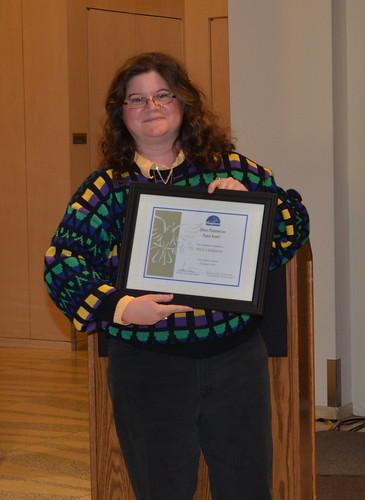
Salvos Prelorentzos Peace Awards 2012, a photo by raise my voice on Flickr.
On November 6, 2012 I received the Salvos Prelorentzos Peace Award from Project Ploughshares at City Hall. In its 17th year, the award is given annually to someone in Edmonton who has worked towards the goals of peace and social justice but who has not yet been formally recognized for their work. I was chosen for my pioneering efforts in documenting the local activist scene and using social media and other online tools to share and connect. This is my acceptance speech. For a full set of photos, click here. For all of the videos, here is the playlist.
Social Media and Social Responsibility
Salvos Prelorentzos Award Acceptance Speech
Paula Kirman
November 6, 2012
When Jim Gurnett called me back in January to inform me that I had been chosen as this year’s recipient, I was at a loss for words – and for someone like myself who makes a living with words, that is indeed very rare. Then, I found myself in a similar situation when I sat down to write my words of acceptance.
So, let me begin by giving thanks. Thank you to Project Ploughshares for making this event possible. Thank you to the award’s organizing committee for selecting me, especially to Alison Scott-Prelorentzos for honouring her late husband in this manner. Thank you to David Climenhaga for speaking tonight, and to Terry Morrison for gracing us with her wonderful music. Congratulations to Mr. Kalia for his lifetime service award. And thank you to all of you for coming out this evening. It really does mean a lot to me, more than I could express.
I am very honoured and humbled to have been chosen as this year’s recipient, especially when I reflect upon the incredible people and organizations who stood up here in past years, many of whom I am privileged to call my friends and my brothers and sisters in our common struggle to bring about a world of peace and justice.
Now, I will tell you a bit about myself. As a child, I made an impassioned plea to my parents for two things: a camera and a guitar. I am fortunate that my parents indulged me, although I have to admit that the guitar took a little more convincing.
Communication is what I do professionally, and there is a need for communication about peace and matters of social justice between organizations, individuals, and the world. We have the technology at our fingertips to do this. I am fortunate to be part of a generation to embrace social media as well as the technological gadgets that make archiving and sharing possible.
Then, it was just a matter of connecting with the local peace community – something I did not know existed until I purposely went about looking for it. When I found it, I showed up at a peace rally with a digital camera and started taking pictures. At that time, I was really the only person taking pictures at these sorts of events, and then the first to get the images online to be shared.
When I saw the possibilities to really show the rest of Edmonton and beyond that the city really does have an active, engaged peace community, this expanded into acquiring a video camera, learning to edit film footage, as well as increasing the number of social networks upon which I share my work while getting into more sophisticated forms of blogging and website design.
I am now so enthusiastic to see others showing up to events with cameras and getting online and sharing and commenting. Those of us who are privileged enough to be able to access and use technology have a choice to use developments like social media for the good of society. It gives us the opportunity to become independent citizen journalists and present our perspectives in a widely public forum but in a way that is very real with a human element.
Equally important to presenting and showcasing the city’s activist movement is sustaining it. In order to make sure the city has a peace movement that stays active, it has to stay relevant and attract younger people. Love it or hate it, the so-called “new media” is how to make this happen. When I do things like get Project Ploughshares onto Facebook and reviving the website for the Edmonton Coalition Against War and Racism it is with a sense of excitement for the future.
Now, about that guitar - when I got involved in the local peace movement, it was a natural transition to write songs with social meaning. I was, after all, raised on a steady diet of Joan Baez and Bob Dylan. It was also a way of being more directly involved with events rather than always just standing on the sidelines with a camera. And again, thanks to social media, I’ve been able to reach an audience far beyond just the people who show up at the events.
At the same time, thanks to social media, my activism has been very public and that is not without its challenges, personally and professionally. But like I said earlier, we have the tools at our fingertips to share and build our movement. It comes down to a matter of choice, and I have considered working towards peace to be a personal responsibility.
And on that note, I will end with the chorus of the song I wrote about choosing to stand up for peace in the face of resistance, called “Walls”:
I can’t sit on the fence anymore
When I have to choose between peace and war
And object to oppression where it arises
No matter what else it is disguised as
I hope that we can all make similar choices in our lives. Thank you.
Thursday, October 18, 2012
New Arena: Cease and Desist
Yesterday, Edmonton's City Council voted to cease all negotiations with the Katz Group.
Apparently, they finally saw the light after years of spending time and money on negotiations with a private company that ultimately proved fruitless. Katz tried to change the terms of the deal, used the media to make these statements of change, and then refused to meet with City Council.
Did City Council make the right decision in this instance? Yes. Do they deserve applause?
No.
We protest-types who were against the private-public partnership deal with the Katz Group from the beginning turned out to be right all along. Katz could not be trusted. Public money should not go to a private enterprise for its own profit.
City Council spent way too much time and resources trying to appeal someone who really, in the long run, doesn't give a rat's posterior about Edmonton. Daryl Katz is a businessman who cares about the bottom line - his bottom line - not what is good for the city.
Will there ever be a new arena? We don't know. If there is, it will hopefully be structured economically so that all profits go back to the City - not into the pockets of a billionaire.
I am still of the mindset that Edmonton doesn't need a new arena. Rexall Place is doing us just fine (though admittedly it will need a facelift at some point) and there is more to life than hockey.
In the meantime, there are roads that need to be repaired, neighbourhoods in need of revitalization, and an LRT that needs to be expanded. Let's spend OUR money on things that are important and will really make Edmonton a better place to live.
Wednesday, September 19, 2012
Big Trucks and the Downtown Arena
A friend of mine jokes every time he sees someone driving an oversized pickup truck. "Compensation issues," he says, while chuckling.
Daryl Katz has compensation issues, and the truck he is driving are the constant threats he makes of moving the Oilers out of Edmonton if he doesn't get his way with the City for the funding of his pet project: the downtown arena.
By now, most of you in Edmonton probably know that the Katzmeister dropped another wrench into negotiations, by insisting the City provide a $6 million annual subsidy for the operations of the arena. Let me clarify the indignity of this: the man is a billionaire, and he is asking for a subsidy? For his own project? That will be making him a profit?
I am one of the crowd who was against public funds for the arena in the first place. One of my concerns (shared by others) was that as plans moved along, Katz would keep finding reasons for needing more and more City money. Well, I hate to say "I told you so," but - I told you so. At least the City has not acquiesced yet. Yet.
This week's bombshell from Katz should be enough to prove to City Council that he cannot be trusted. Yes, he is going to go before Council to "explain himself" - but really, if anything was a warning sign, this is it. What is to stop him from, after ground is broken and construction begins, from finding some reason why more public funds are needed? Or from him pulling out altogether and leaving taxpayers to deal with the fall out?
The threat of Katz moving the Oilers - that big truck he is driving - seems real, and is a motivator. Even as someone who is not a sports person, I know losing the Oilers would hurt Edmonton. First of all, I don't think a team can be moved without the administration of the NHL approving the move. The market is saturated and there really are not a lot of places the Oilers could go.
The NHL is in the midst of a lock out. No hockey season at the moment. Are cities who actually have NHL teams that win games no longer "world class"? I think not. If Edmonton had no team, it would make us no less world class than we are now. Something else would rise to fill the void. The city is more than hockey.
In fact, an arena really makes no difference either to downtown revitalization or the city's standing as "world class" (which I put in quotation marks because, really - what does that mean? Who decides what "world class" actually is? And does it have to be the same for each city?). Over the next couple of months, Bob Dylan and Paul McCartney respectively will be performing at the Rexall. In the world of musical entertainment, it doesn't get much bigger than those two. And Edmonton attracted them - without an arena. Who would have thought it?
City Council should call Katz's bluff. This isn't "Katzmonton." A billionnaire should not be trying to push City Council around, regardless of how big his truck is. because in the end, the truck is just a prop.
Sunday, March 25, 2012
Raise My Voice Becomes Radical Citizen Media
In September of 2005 I attended a peace march. I brought a camera and took pictures. I posted those pictures online. This behaviour became a habit.
People looked at the photos. They looked a lot. So much, in fact, that the server I posted them on, crashed.
As a result, I purchased a domain and hosting plan. The website was called RaiseMyVoice.com and became a portal to the photos and videos I shot at rallies and events concerning human rights, social justice, the environment, women's issues, poverty, and a host of other topics, mostly from progressive and left of centre viewpoints.
After a while, the website became one of the largest historical archives of citizen engagement in Edmonton at such events. RaiseMyVoice.com needed to be updated more and more frequently, and required more categories, better organization, and a cleaner look.
This week, RaiseMyVoice.com got the overhaul it needed. It was such an overhaul that I decided to change the website entirely.
With the new look comes a new name: Radical Citizen Media.
There are more events organized by subject matter than ever. More categories. The videos are easier to find. Photo sets lost and broken have been found and fixed. The design is cleaner, navigation is easier, and updates now include embedded photos and videos.
I have been called Edmonton's Indymedia because of my commitment to documenting progressive and left-wing citizen engagement in Edmonton. That commitment is going to be met even better moving forward. Radical Citizen Media is now both a serious part of Edmonton's media scene and valuable historical archive.
Wednesday, March 21, 2012
Introducing Friends of Church Street
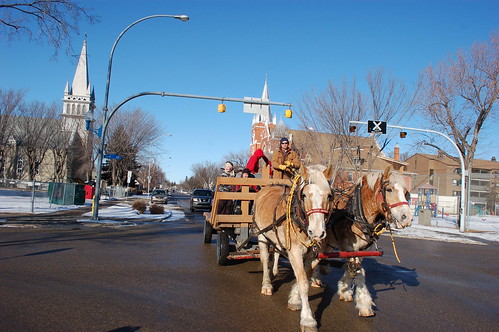
The horse-drawn wagon depicted above is winding its way through Church Street. To the left is Queen of Martyrs Vietnamese Catholic Church, and on the right is Sacred Heart Church of the First Peoples.
Church Street is one of Edmonton's most valuable historic resources. Although not officially called that - yet - Church Street is located along and around 96 Street in the McCauley neighbourhood, part of the inner city which is currently undergoing revitalization efforts.
Friends of Church Street is a new organization seeking to promote the historical significance of the area. It all started in the fall of 2010 when I was a Community Animator for McCauley with Action for Healthy Communities. Part of my job was to encourage and facilitate residents in grassroots community initiatives. One such initiative was the McCauley Connects Coffeehouse, which regularly features local talent.
The other initiative came from a woman named Colleen Chapman, who also happens to share Volunteer Coordinator duties with me at Boyle McCauley News. Church Street was in the process of being honoured by the Edmonton Historical Society and Colleen thought it would be great to have a Church Street Fair in the summer of 2011.
Planning an event of this magnitude proved to be too much for just a few months, so the event ended up getting pushed ahead to 2013. However, in the meantime, Colleen gathered together a group of community members and boosters to form Friends of Church Street. I am the Communications Director, and in addition to planning the Fair, we seek to raise awareness of and attention towards the history, architecture, and importance of Church Street.
The City of Edmonton is indeed taking notice of just how important the area is. This article, published in the February 27 issue of the Edmonton Journal, reveals that the City may very well make the name Church Street official.
Church Street is a boost to both McCauley's revitalization and the City in general. There is a rich history behind many of the churches, and the architecture is spectacular. In fact, Church Street has put Edmonton in the Guinness Book of World Records - 96 Street still holds the record for the highest concentration of churches within the few blocks it spans.
We launched our website today and are also on Facebook and Twitter (@ChurchStreet96).
What are some of your ideas concerning Church Street? Any suggestions for the fair? Walking tours? Souvenirs? Contact us and get involved!
Friday, March 02, 2012
A Dubious Honour: Nestle Protest
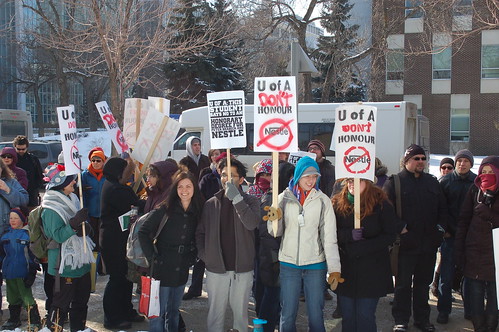
An honorary degree is a very high accolade to bestow upon someone. Peter Brabeck-Letmathe, Chair of Nestle, received this honour yesterday from the University of Alberta.
The decision to award Brabeck-Letmathe in this way came with controversy since day one of it being announced. The outcry against the U of A's decision came to a head yesterday when a rally was held outside the Timms Centre for the Arts shortly before the ceremony was set to begin.
Breastfeeding advocates, almuni, experts in water security, students, parents, and professors spoke (in varying combinations,such as a breastfeeding advocate with five children of her own, and a professor who is an environmental specialist).
The bottom line was that Nestle has had a spotty record in its actions as a multinational corporation, particularly in two areas. First, by selling its baby formula to women in the Third World by saying it was better than breast milk. In these countries, water is scarce and often contaminated. Formula has to be mixed with water. Babies were getting sick and dying, and by the time the mothers realized what was wrong, their own breast milk had dried up.
The other thing is Nestle's treatment of water as a commodity. It views water as a foodstuff and is responsible for much of the waste that is bottled water.
One of the speakers raised some excellent questions, asking why precisely this person was chosen to receive an honorary degree instead of being recognized some other way. Why the highest honour a degree-granting institution can give?
The excellent turnout at the rally (I counted between 150-200 people at its peak) demonstrates that people are watching and people do care when it comes to the actions of the University of Alberta. The U of A has a history of excellence which would be painful to see overshadowed by it selling out to corporate interests.
Here is my photo set of the rally.
Thursday, March 01, 2012
Attention Please: WCB Injured Workers Rally
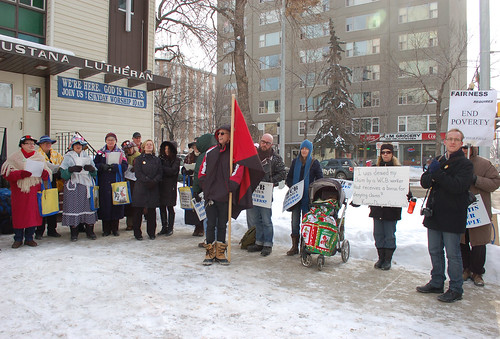
You're a worker. You get injured on the job. You make a claim to the Workers Compensation Board. However, your claim is denied. Or, you are met with a maze of paperwork around every corner and doctor's appointment.
Yesterday was the first of three days of protest of injured workers who say that their have been treated unfairly by the WCB. The rally was organized by the workers themselves with support from Occupy Edmonton.
The workers spoke, telling their stories amongst speeches from MLAs and provincial candidates, the songs of the Raging Grannies, and some insight from a local psychologist who has worked on WCB cases.
With a provincial election a couple of months away, the operations of the WCB may become an issue for discussion. The conclusion of everyone who spoke was that the system is broken and in need of an immediate Provincial investigation and reform. Although I personally have never had any dealings with the WCB, I was quite concerned with what I was hearing and think that the stories of these workers is good fodder for some investigative journalism.
Here are the rest of my photos.
Saturday, February 25, 2012
Cool Stuff in a Winter City

Winter is a part of life in Edmonton. In fact, as a born and bred Edmontonian, I can't really imagine life without it. We've had it easy this year (for the most part - as I write this, centimetre upon centimetre is falling from the sky at a very fast rate), but the winter of 2011 reminded me of the ones when I was a child: long, snowy, and COLD!
An exhibit in Enterprise Square until the end of March examines the area through the lens of winter. Cool Stuff features more than 350 items from the University of Alberta's 29 museums. Artwork, clothing, animal specimens, and other artefacts exemplify life in the northern winter, both now and throughout history. Some items that really stood out for me were items of Inuit dress, as well as the colourful artwork by Ted Harrison.
Winter is something that has been on the City's mind for a while now. The WinterCity Strategy is part of an effort to encourage peopel to embrace the winter and present Edmonton as a world leader in celebrating our climate.
Winter has been celebrated in Edmonton through several festivals, such as Silver Skate (the longest-running winter festival in Edmonton), Ice on Whyte, the various efforts of the Edmonton Winter Light Society, and most recently, Metropolis.
Since staying inside is not going to make the snow and cold going away, activities that encourage people to get outside and take part in activities is quite important, even if it is just admiring sculptures of snow and ice. Offering some coverage to allow people to warm up is also important, but putting everything inside, even if it just within temporary structures (like with Metropolis) is counter-productive. If I want to go to an indoor activity, I would rather go see a band perform in a concert venue, a movie in a theatre, or a conference at a hotel.
That being said, having one-off events like the recent Parka Patio presented by Latitude 53 had a little bit of everything: food, music, and art in a setting modified to accommodate the weather and make sure everyone was comfortable.
I am a big fan of hyper-local, neighbourhood celebrations; ones that not only offer things to enjoy for local residents, but are actually a reason for people from other parts of the city to head over and experience life outside their immediate environment. I am thinking about Common Ground in McCauley, which was part of the Winter Light series of events. Music, storytelling, food, and outdoor installations were just part of this incredible event. Performances took part inside teepees heated by fire, while there was plenty outside to see and do. And those in attendance were not just from the inner city.
Keep it relevant, keep it multifaceted, and keep it focussed on local culture, food, and entertainment, and combine it with planning that takes into account the unpredictable fluctuations in weather that our winters are famous for, and that is a winning combination. No event or strategy will be all things to all people, so it is important to have a variety of options instead of pushing one major "winter festival."
Then, there are the practical details that should always be a priority for Edmonton's City Council, if we want the city to be truly safe and sustainable year round. More cycling lanes will ensure that those brave (or crazy!) enough to ride on two wheels in the winter will not have as much traffic with which to contend. Road maintenance and effective snow clearing and sanding are definitely important.
Finally, the activist in me has to get this in: the City needs effective, continuing strategies on dealing with homelessness and affordable housing. These are issues that increase in urgency when the weather gets colder. Since we have such a long winter season combined with a significant homeless population (as well as those at risk) and shelters that become overextended to the maximum, this needs to be a top priority. After all, to me at least, exactly how "world class" a city is directly relates to how well it takes care of those citizens who are most vulnerable.
We can embrace the climate in Edmonton as well as everyone who lives here. We have the minds, the talent, and the ability.
Monday, January 16, 2012
Torture Does not Fight Terrorism: Rally to Close Guantanamo & Bring Omar Khadr Home
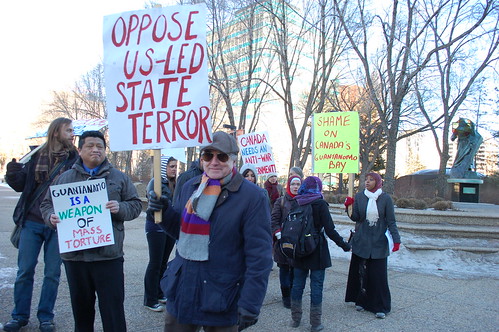
On January 7, a group of students from the local branch of Canadians for Justice and Peace in the Middle East (CJPME) organized a peaceful protest outside of the Alberta Legislature, calling for Canada to support closing Guantanamo and bringing child soldier Omar Khadr home.
I took part in a similar rally around two years ago, at Churchill Square.
Like many of the causes with which I am involved, this seems to be one that is very divisive. I am going to list the arguments that I have been encountering, and explain the rationale behind the perspective that Guantanamo should be closed and Omar Khadr should be be brought back to Canada for a fair trial.
Omar Khadr is a terrorist.
When someone is on our side, that person is a war hero; when they are on the other side, that person is a terrorist. One nation's terrorist is another nation's freedom fighter. Omar Khadr was a child soldier in a war (an illegal and unjust war, at that), and in a war, people get killed (which is one reason me and my cohorts protest against it). If Khadr's actions were criminal, he should be tried, then possibly convicted and sentenced. Instead, he has been languishing in a prison for ten years, without a trial.
Excuse me - he pleaded guilty.
What choice did he have? Since his own country, Canada, would not take him back to try him here, it was probably the only way Khadr and his lawyers felt he would ever see the light of day.
His whole family is a bunch of terrorists.
See my original point. Assuming this is true, it only supports the need for Khadr to be tried in Canada as a Canadian. Likely, at his young age he was under the influence of his family for whatever actions he committed.
He was old enough to know what he was doing.
He was a young teenager. Young teens can be open to influence and easily manipulated. A fourteen year old in Canada who commits murder is usually tried as a child (yes, a murder charge can be bumped up to adult court, but even still, he would not have been imprisoned indefinitely and subject to torture).
Do you think the majority of Canadians agree with your view?
I honestly don't know - I have never conducted a poll. However, that is irrelevant. How the nation conducts itself in this situation is the difference between a government that has a foreign policy that simply follows the lead of the US, or one that holds up values of international law and justice. You see, the use of torture against prisoners of war is illegal. It is also ineffective. A person will say anything to make the torture stop. So, a confession acquired through the use of torture is invalid, as far as I am concerned.
As well, Canada is the only country who has not taken back a citizen from Guantanamo. All of the other countries have taken back their nationals and dealt with them on their home turfs. I see no compelling reason why Canada should act any differently.
I know these are controversial issues and I don't expect everyone to agree with me. Nor am I saying that Khadr is innocent of any wrong-doing. What I and my cohorts are saying is that the way the Canadian government has done one of its citizens a disservice and by doing so, has tarnished Canada's image to the world.
Here is my full set of photos from the event.
A video of highlights from most of the speakers:
The short march around the Legislature pool:
Thursday, January 05, 2012
Art for Awareness: Homeless Memorial Sculpture

A new piece of public art was unveiled in Edmonton in November. It is a sculpture that honours those in the city who live their lives without adequate housing. Located just north of City Hall on 99 Street, it was created by local sculptures Keith Turnbull and Ritchie Velthuis. I finally got a chance to go and photograph the sculpture this week.
The cost of the sculpture was $40,000 - a price tag that made some cringe. They questioned the use of public funds in this manner, expressing doubt that such a piece of art can actually help the homeless.
While it is true that the agencies and shelters who help the homeless (and those at risk) are often underfunded, a piece of public art such as this tribute has its place.
First of all, it raises awareness of the issue. It is a visually striking reminder to anyone who sees it, that there are those in this affluent city who live either without adequate shelter or who are on the margins and one step away from such a fate. As well, people with direct experience of homelessness took part in the creation of the sculpture. Tiles designed and made by these people are featured prominently - and, they were paid for their contributions.
A memorial for men and women who have lost their lives as a direct result of not having a home is usually held in January. However, according to one of the organizers, this year the date is yet to be determined. The hope is to have the memorial outside at the sculpture.
Public art has been viewed with some skepticism lately, due to the unveiling of the Talus Dome on Fox Drive, which cost $600,000, was made by an artist in L.A., and which most people can't seem to figure out. However, sometimes the price is justified. The homeless memorial sculpture has value that goes beyond money.
Tuesday, November 22, 2011
Occupy Edmonton - Why We Should Care
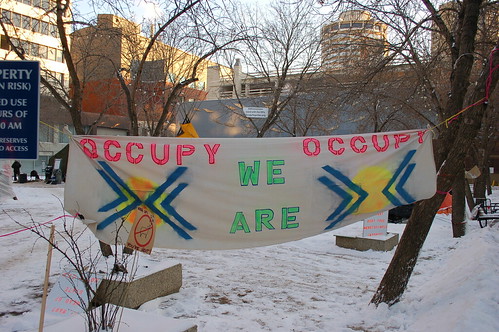
I attended most of The Parkland Institute's Fall Conference over the weekend. The topic dealt with the economy and the growing divide in society between classes, as well as attacks upon workers and unions. Much of what was discussed was in the context of the Occupy movement.
There could not be a more timely topic, as Occupy Edmonton has been holding strong for over a month now in the park owned by Melcor at 102 Street and Jasper Avenue. Despite a heavy snowfall and dramatically cold weather, a small group of campers have maintained at the site, having winterized (including putting up a military tent complete with a disco ball for entertainment shows).
Yet another deadline for eviction (I think this is the third) by Melcor has come and gone, with the Occupiers refusing to leave, offering up instead a list of demands.
This situation has brought about mixed reactions, even within the activist community itself. I met up with several long-time activists at the conference who felt that Occupy was a diversion from other, more pressing matters, like the dismantling of the Wheat Board. They also stated that Occupy doesn't seem to stand for anything, that its demands are not clear.
I respectfully disagree. First of all, it is just wonderful in general to see younger people standing up for something. At the various Occupy rallies and at the camp itself, I have met numerous people I have never seen before - and I have been kicking around the activist community for a good number of years now.
Secondly. if Occupy is accomplishing anything, it is raising awareness of the fact that the current economic system is not working as it should, in that corporations are getting breaks and exemptions that the common workers never gets. The rich get richer and the poor get poorer. That's the message I am getting.
I've also been hearing the arguments from a number of sides and political stripes that it is getting too cold to camp (so this is becoming a safety issue) and the fact that the group is on privately-owned land, and they should, in fact, occupy public land instead. These two issues (safety and private vs. public) are likely becoming the real diversions because Occupy is actually about more than just a camp itself.
Yes, safety is an issue, but these people are very passionate about spreading their message. And for those who say there is no message, I think the list of demands is pretty clear - lofty goals, yes, but clear nonetheless. As for the decision to be on privately owned land, I am going to go out on a limb here and suggest that Occupy Edmonton is making a statement that a corporation is not a person, as opposed to how said entities are treated legally and economically. However, if Occupy Edmonton does get evicted or chooses to leave that specific site, I know there is a Plan B (and C, and likely D).
Occupy is a global movement that will continue in one form or another. Maybe it will not change the world overnight, but there will be effects. We are witnessing one of the most important social movements of our time.
Tuesday, October 25, 2011
Hopes for Downtown
Today, a public hearing was held into the proposed downtown arena. People representing different sides of the issue had a chance to address City Council and speak their minds.
As for me, I am not sure I have much to add to this, specifically. I am not against large developments in the downtown area per se, but I do have a problem with a funding structure that will finance a private business using taxpayers' dollars. So, I do have some concerns with the City entering into a deal with a billionaire who is out to make a profit.
That aside, I also have an issue with thinking that Edmonton absolutely, positively needs a project on the scale of the proposed arena in order to keep downtown alive and vibrant. I have a little observation: downtown Edmonton already is alive and vibrant. Sure, there are pockets that are not developed to their fullest extents, and a few places here and there that can seem a bit sketchy. But overall, there are always places to go, things to do, and events going on in the city's core. If we don't get a new arena, downtown is not going to crumble and implode. There is already a new art gallery, a new museum going up, and lots of revitalization in the area. Festivals and events take place galore. New businesses like coffee shops and cafes create excellent meeting places. Downtown Edmonton does not need to be fixed because it isn't broken.
Downtown has a lot of history and a bright future - with or without the arena. Fancy, shiny new things do not necessarily improve society. In fact, I am not sure enough due diligence has been given to the effects a project on the scale of the proposed arena would have on housing and other social issues in the area.
From reading this, you can probably guess I am somewhat leery of the whole thing. Not as someone afraid of change or who doesn't want to see downtown boosted to its maximum potential, as those against the project have been accused. Edmonton is about more than hockey and jumping on bandwagons just because someone slick is trying to sell us something and convince us that we need it.
My ideal downtown is a place of arts, of festivals, of music, and a place where issues like hunger and housing are dealt with effectively. Whether a new arena can help or hinder these goals remains to be seen - and a lot of it has to do with how it is financed, what it will do to surrounding property values, how badly it will congest certain areas, and how it will affect surrounding social organizations. There is too much that is simply not known and given the history of talks behind closed doors and potential done deals made without public input, I am not confident that City Council will let us know enough to make informed decisions or hold a plebescite.
In the meantime, I am going to enjoy downtown for the wonderful entity it already is.
Wednesday, October 19, 2011
Occupy Edmonton - Reflections on a Movement
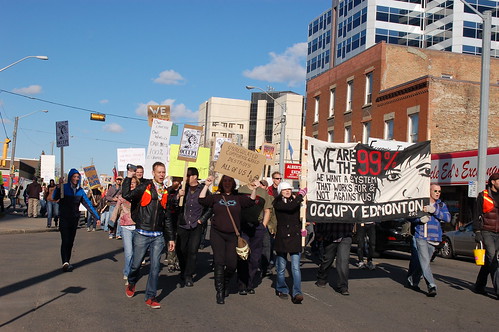
This past Saturday, Edmonton joined the growing number of cities around the world in the Occupy movement.
It all started on Wall Street in New York last month, when a grassroots group of individuals decided that they had enough of corporations getting tax breaks, bailouts, and other economic benefits not available to the average person, laden with taxes, debt, and other financial woes for which there are no subsidies or bailouts. The "occupation" involved camping out in the financial district of the city.
Soon, other groups of activists in other cities began doing something similar, in solidarity with the Wall Street campers, but also because this sort of economic unfairness happens all over. Corporations (and the people who run them) are only 1% of the population, while the other 99% pick up the slack.
October 15 was the Canadian day of action, and Edmonton saw at least 1500 people fill Churchill Square for a rally and march. Afterwards, around 50 or so people set up camp in a park on 102 Street and Jasper Avenue, where they remain as of the time I am writing this blog post.
The Occupy movement has taken a lot of criticism on two fronts: one, that is it is leaderless and two, that there is no clear agenda of what exactly people want. To address the first issue, a movement does not necessarily have to have a leader per se. A grassroots movement is exactly that - a group. Decisions can be made by consensus or in whatever way the group decides. The Edmonton model has been run via consensus.
As for the second, there are lots of things people tossed around as demands. Does a protest necessarily have to have one thing as a resolution? My summation, when asked, is that we need a more just economy that supports everyone, instead of putting corporate interests above all else. How that should come about - now, that is something that can have many different theories. There have been a number of general assemblies where the people involved in the camp discuss their strategies for effecting social change. I have not attended any of these, so I cannot comment further.
The same can be said of the peace movement, of which I am also a part. We all agree that war is wrong - how we achieve peace is where we have different ideas. We dialogue. It's all part of the process.
Occupy Edmonton is one of the largest rallies I have attended in around six years of attending, organizing, and participating in the activist scene. Obviously, a lot of people are concerned about the way our economy runs and it is not something to mock or ignore, whether or not solutions are immediately forthcoming.
In fact, I was recently asked about immediate, concrete results coming from a local protest. My answer is that the purpose of protests like marches and rallies is not to bring about immediate results. It is to raise awareness and to speak out. Again, this is all part of the process. It is a forum for expressing ideas and to educate others. People always ask me after events, even if they did not attend but see my photos and videos online, what the issues are. This brings the chance to educate. And then they tell me their perspective, and I learn from them.
There are always activists who get defensive when questioned about their motives, particularly because we have a tendency to get ridiculed for our actions and beliefs. It is unfortunately when lines of communication get muddied, but these experiences do not change the underlying reasons for the protest in the first place.
Whether or not Occupy Edmonton (or the Occupy movement in general) will have any long-term, lasting effects remains to be seen. However, it is a large-scale, bold example of free speech and democracy in action, and for that reason alone, should be encouraged.
To view my entire photo set from the march and rally, click here. For a video play list of all of the speakers and music, click here.
And a disclaimer: I was involved in some of the organizing of the Occupy Edmonton event on October 15 and sang at the rally.
Friday, October 07, 2011
Orchids: Mystery & Romance

I love photographing flowers, and orchids are a particular favourite. Orchids have an incredible range of colours and their shape is sensual and compelling. Thus, I was thrilled to attend a preview of the new display in the Feature Pyramid of the Muttart Conservatory this afternoon.
Orchids: Mystery and Romance celebrates the 20th anniversary of the Orchid Species Preservation Foundation. The arrangements are colourful and unique, and feature stories and myths surrounding orchids. It runs from October 8-23. It's a short show because orchids have a short blooming season.
My favourite part of the exhibit is the rainbow made entirely of orchids. As well, there are numerous explanations of myths and stories about orchids from throughout history.
I can't imagine how many hours were spent putting this whole show together. I go to the Muttart on a regular basis, and this is definitely one of the most intricate shows I have ever seen there.
Subscribe to:
Posts (Atom)