Showing posts with label jewish. Show all posts

Monday, November 23, 2020

ANNOUNCING JEWISH EDMONTON STORIES ONLINE PROJECT

I am happy to announce that I will be working on the following project in collaboration with #YEGFilm and the cooperation of several community organizations. 

JEWISH EDMONTON STORIES ONLINE PROJECT SEEKS PARTICIPANTS

Jewish Edmonton Stories Online, a project for Jewish and non-Jewish Edmontonians alike to learn and connect with the stories and places of our community’s past, will launch in the fall of 2021. We are seeking remarkable stories and memories from interested members of Edmonton’s Jewish community that connect to a particular place in the City. Stories do not have to be submitted in a complete format. At this point, we're looking for story ideas and summaries. We will follow up with you once the stories are selected for sharing on our coming interactive storytelling website. Stories will be recorded via audio, video, and/or written transcription via an interview process.

We intend for the stories to represent diversity within the Jewish community, including, but not limited to elders, Sephardim and Mizrahim, women, LGBTQ individuals, and people with disabilities. All recording will be carried out safely with COVID-19 protocols in place. The storyteller will be paid a small honorarium. At this time when we are physically isolated due to COVID-19, it’s important to reach out in as many ways possible to connect and share our community’s knowledge, history, and experiences.

This project is being made possible with the support of the Edmonton Heritage Council, JAHSENA, WordsPicturesMusic.com, #YEGFilm, and the Jewish Federation of Edmonton. To share your story, or for more information, feel free to connect with us at stories@jewishedmontonstories.ca. Deadline for stories: March 1, 2021.

Monday, October 01, 2018

#HateFreeYEG Lanches

#HateFreeYEG is a new grassroots community initiative to work towards eradicating Edmonton of hate and racism. The initiative launched on September 30, and I was asked to speak at the launch as a community organizer about how we can eliminate hate, as well as my own experiences with anti-Semitism. Here is a video of my talk, as well as my notes.

--

Shalom and thank you for inviting me to speak this afternoon and to join my voice with all of us here who proclaim that hate is not welcome in Edmonton. I am with the Edmonton Coalition Against War and Racism and the Edmonton Interfaith Centre for Education. I am also a Jewish woman.

As a Jewish woman, the growing resurgence of ultra right-wing hate groups concerns me greatly. My own community has been affected recently, with swastikas being spray painted on buildings in several southwest neighbourhoods. It stands to reason that the same kinds of people who would express hate towards immigrants, Muslims, and people of colour are the same kinds of people who would be anti-Jewish. Also, as a Jew I feel a need to stand up against hatred because of my roots and my faith. Many Jewish people of my generation are the descendants of immigrants and refugees. I am also vigilant against Islamophobia not only because hatred is just plain wrong, but also because of the shared Abrahamic roots of our faiths.

In fact, my commitment to social justice and human rights stems largely from my Jewish background. In Judaism, there is a value called tikkun olam, which translates to healing or repairing the world. We all have that potential within us, regardless of our background, to make the world a better place. It doesn't have to be through grand gestures or high-profile acts – every day, we all have opportunities to make the world around us safer, and to fill it with more compassion, hope, and love.

At various times in my life I have had experiences with anti-Semitism. It's often been a subtle undercurrent, sometimes taking the form of jokes or comments perpetuating various stereotypes like being cheap, or being part of some kind of power conspiracy. Anti-Semitism has sometimes crossed over into sentiments that are misogynist, like body shaming, or calling a Jewish woman a nag, or the ubiquitous Jewish mother jokes. I've been told at times I don't “look” Jewish, as though that is a compliment. It isn't. Some anti-Semitism I have faced or witnessed also crosses a line into been ableist, like being referred to as neurotic or controlling – attributing to one's culture symptoms of mental illness which may or may not actually be real. After all, you don't always know what someone might be struggling with.

I recall when I was accosted by a man on an isolated street in the inner city. He had seen my Star of David around my neck, and thought it was appropriate to stop me – a complete stranger – and ask if I was Jewish. I said yes, keeping a wide physical distance from this person. He then proceeded to interrogate me, asking where I was from, and not accepting Edmonton as the answer. He finally backed off when I gave him some general response about my distant Eastern European heritage. After that experience, I have found myself feeling defensive when someone asks about my choice of jewelry. I enjoy meeting new people and talking about myself and learning about them, but being “othered” time and time again can sometimes make a person overly sensitive to inquiries about their background, which is unfortunate because having conversations about ourselves can lead to greater understanding.

Planting the seeds against racism and hate need to start early. We also all know that kid from school who was always being picked on, pushed around, made fun of, teased, beaten up, and pushed around some more. I know – because I was that kid. I believe that a lot of my values towards kindness, love, and being against racism and hate comes from the fact that I was badly bullied as a child and teenager and I don't want to see that happen to anyone. When we see bullying, when we see people being made fun of because they are somehow different, when we see hatred in our midst we have an obligation to stand up, intervene and say that this is wrong.

In closing, I also wanted to say that I am a board member with the Edmonton Interfaith Centre for Education and Action, and what we do is to seek to achieve peace and harmony and an end to racism in the world through teaching about different faiths, not from a religious point of view, but from an educational one. I encourage you to look us up and see what we have to offer, and to become a member and get involved.

Thursday, December 14, 2017

Speech at Hands Off Jerusalem Rally

I was asked to speak on December 5, 2017 by the organizers of an emergency rally to protest the announcement of the intention to move the U.S. Embassy to Jerusalem, and declaring Jerusalem as the capital of Israel. Here is the text of my speech as well as the video from the event.


I am a human rights activist. I am a Jewish person. I am a global citizen. But most of all I am someone who wants to see peace for all peoples of the world. The world became a more dangerous place this past week, and we cannot sit idly by.

The decision to move the U.S. Embassy to Jerusalem and to recognize Jerusalem as the capital of Israel is nothing less than an act of war, a provocative move that will further destabilize the region and result in unnecessary and inhumane suffering.

It is a decision that is being criticized by people from all three Abrahamic faiths. This is no surprise since Jerusalem is an international city that is sacred to Muslims, Jews, and Christians in Israel, Palestine, and around the world. Resolution 476 of the United Nations Security Council says that altering the character and state of Jerusalem is a violation of the Fourth Geneva Convention and has no legal validity.

Such a move will only deepen the oppression of the Palestinian people by giving the Israeli government a clear signal that the US will continue to support and aid the immoral and illegal occupation of Palestine. It will do nothing to achieve a just and lasting peace in Palestine and Israel. Demonstrations have already been happening in the West Bank. Festive lights are being dimmed and seasonal celebrations are being cancelled in Bethlehem, which is the occupied West Bank town where, according to the Christian faith, Jesus was born.

Today is the United Nations' Human Rights Day. How appropriate that we gather here to protest how both Palestinians and Israelis – the majority of whom want peace for themselves and their children – are being used as political pawns. In Judaism, we have a value called Tikkun Olam, which means to heal or repair the world. We cannot support that which will further tear the world apart. In the name of a just and lasting peace, we must say no to the US embassy in Jerusalem, and an end to the occupation.

Wednesday, December 13, 2017

Explaining Chanukah to Atheists

Is Chanukah really the "Jewish Christmas"? Why do we light candles and eat oily food? If a man converts to Judaism, it's going to hurt in the end, right? These, and other questions, were addressed during my presentation about Chanukah to the Society of Edmonton Atheists on December 5. (Spoiler: the answer to the last question is "most likely, yes.").

Thursday, July 07, 2016

Speaking at a Rally for Palestine

On July 2, I spoke at a rally for Palestine. This time, I was speaking strictly for myself, and not on behalf of any organization. Although it was organized to recognize the controversial Al Quds Day (an observance for Palestine originally started in Iran), I was very impressed that most of the speakers were saying that this was a day to recognize all of the oppressed and occupied peoples of the world, including our own First Nations. While I was specifically asked to speak about BDS and the situation involving access to water in the West Bank, I also acknowledged that I disagree with violence on either side of the conflict in Israel/Palestine. It was a peaceful and respectful gathering, and while I was at first conflicted about speaking there, I was glad afterwards that I did. Below is my speech and a video from the event.
My name is Paula and I am not speaking on behalf of any organization: I am simply speaking as a Jewish citizen who believes that the occupation of Palestine must end. Judaism and Zionism are not the same thing. Despite the efforts of organizations like B'nai B'rith and the Centre for Israel and Jewish Affairs that claim to speak on behalf of the entire Jewish community, there is growing concern among Jewish people in Canada and beyond about the actions of the Israeli government and its human rights atrocities aimed at the Palestinians. I say: not in my name!

An end to the occupation is needed for a just and sustainable peace in the Middle East. The occupation, besides being illegal and immoral, does not allow either the Palestinians or the Israelis to live in peace and risks continued escalations of violence against both peoples – not to mention the horrific human rights abuses that the Palestinian people must face every day.

Boycotts, Divestments, and Sanctions, better known as BDS, is one tactic to protest the occupation. BDS targets companies and products produced in Israel, particularly in the Occupied Territories. The BDS movement has come under fire this year by the Canadian government, which passed a motion in Parliament to condemn those who support BDS and reject it. As a peace activist, I fear that such a motion is a slippery slope to delegitimize people and organizations for their political beliefs. BDS is a peaceful, non-violent means of protest – it is, in fact, simply a conscious act of refraining from something - that takes both a political and moral stand. For the government to condemn people for their beliefs is overstepping boundaries in a way that has no place in a democratic society.

As a Jewish person, my spiritual practise includes tikkun 'olam, which means healing or repairing the world. Our faith and history teach us that we must stand up in the face of injustice. When it comes to the plight of the Palestinian people, the word “injustice” barely begins to cover it. The latest outrage concerns allegations that the main supply of water to Palestinian towns and cities such as Jenin, several Nablus villages, and surrounding areas was manipulated during the holy month of Ramadan. The executive director of a Palestinian NGO focused on water and sanitation issues reported to Al Jazeera that some areas had not received water for more than 40 days, with families having to live on two, three, or 10 litres per capita per day.

Water is a basic human right. According to the UN, 7.5 litres per person, per day is the minimum requirement for most people, but areas of Palestine reach more than 35 degrees Celcius in temperature, so much more is needed. As also reported on Al Jazeera, Israelis, including settlers, consume five times more water than Palestinians in the West Bank: 350 litres per person per day in Israel compared with 60 litres per day in the West Bank. According to Amnesty International, almost 200,00 Palestinians in the West Bank do not have access to running water, and require permission before collecting it themselves.

Getting back to my stance as a Jewish person of conscience, I have been accused of being a “self-hating Jew” and someone even once asked me why I hate Israel. For the record, I don't hate Israel – I have never said that in any discourse, publicly or otherwise. For the record, any senseless deaths of anyone saddens me, and I don't believe that acts of violence accomplish anything except beget more violence. Ending the occupation will save lives, both Israeli and Palestinian, and is the only path leading to a just and lasting peace.

Monday, May 16, 2016

Weeping for the Land: Jewish Spiritual Solutions to Healing the Environment

I was privileged to be asked to speak at the Edmonton Interfaith Centre for Education and Action's one-day symposium "Weeping for the Land: Spiritual Perspectives on and Strategies for Healing an Ailing Planet" on May 12. My topic was Judaism and spiritual solutions to healing the planet. Below is the text of my talk, and the video from it.

Environmental Justice is a Jewish value.

First of all, I want to clarify that I am speaking as an individual. I am not a rabbi and I am certainly not a scientist. I am an activist, and much of what I will present is from that perspective.

Jewish tradition teaches that God created the world, and as such as ownership of the land, and it is our job, as stewards of the land, to protect and preserve it. This is a value that is common to other faiths, particularly Abrahamic ones, but there are some specific Jewish teachings that deal with Judaism and the environment. I am going to examine just a few of these that are based in the Torah and Talmud.

Much of what I am going to discuss comes from GreenFaith.org and is written by Rabbi Lawrence Troster ("Ten Jewish Teachings on Judaism and the Environment"). What follows are either his words or my paraphrases of them:

The Torah has numerous laws, which attempt to redress the power and economic imbalances in human society and Creation. Examples are the Sabbatical year (Exodus 23:11, Leviticus 25:2-5, Deuteronomy 15:1-4) and the Jubilee (Leviticus 25:8-24). There is a whole program in the Torah for creating a balanced distribution of resources across society (Exodus 22:24-26, Leviticus 25:36-37, Deuteronomy 23:20-1, 24:6,10-13,17). This is an expression of the concept of Tzedek, which means righteousness, justice and equity. It is the value, which tries to correct the imbalances, which humans create in society and in the natural world. In the modern world globalization has strived to achieve the free movement of people, information, money, goods and services but it can also create major disruptions in local cultures and environments. While globalization has created great wealth for millions of people, many millions more have been bypassed by its benefits and it has had in some cases a negative impact upon the environment and human rights. The Jewish concept of Tzedek demands that we create a worldwide economy that is sustainable and that is equitable in the distribution of wealth and resources.

Torah: Prohibition of wasteful consumption
Deut. 20_19-20 “When in your war against a city you have to besiege it a long time in order to capture it, you must not destroy its trees, wielding the ax against them. You may eat of them, but you must not cut them down. Are trees of the field human to withdraw before you into the besieged city? Only trees that you know do not yield food may be destroyed; you may cut them down for constructing siege works against the city that is waging war on you, until it has been reduced.” This law was expanded into a mitzvah (commandment) of Bal Taschlit – Do Not Destroy, and includes the wanton destruction of household goods, clothes, buildings, springs, food, or wasteful consumption of anything.

“Modesty in consumption is a value that Jews have held for centuries. For example one is not supposed to be excessive in eating and drinking or in the kind of clothes that one wears (Rambam, Mishneh Torah, Laws of Discernment,chapter 5). Jews are obligated to consider carefully our real needs whenever we purchase anything. We are obligated when we have a simchah (a celebration like a wedding or Bar Mitzvah) to consider whether we need to have elaborate meals and wasteful decorations. We are obligated to consider our energy use and the sources from which it comes.”

Torah: Prohibition of the Extinction of Species and Causing undue pain to non-human creatures
This is an underlying reason for certain laws pertaining to Kashruth – kosher – food, in terms of the procedure by which to kill an animal in a way that causes as little pain as possible (supposedly, although some Jewish people, like in the general population, have taken this one step further by becoming vegetarian).

“If along the road, you chance upon a bird’s nest, in any tree or on the ground, with fledglings or eggs and the mother sitting over the fledglings or on the eggs, do not take the mother with her young. Let the mother go, and take only the young, in order that you may fare well and have a long life.” (Deuteronomy 22:6-7)

Ramban (Moses ben Nachman, Nachmanides, 1194-1270) in his commentary to the Torah wrote: “This also is an explanatory commandment of the prohibition you shall not kill it [the mother] and its young both in one day (Leviticus 22:28). The reason for both [commandments] is that we should not have a cruel heart and not be compassionate, or it may be that Scripture does not permit us to destroy a species altogether, although it permits slaughter [for food] within that group. Now the person who kills the mother and the young in one day or takes them when they are free to fly, [it is regarded] as though they have destroyed that species.”

The spiritual solution for environmental issues is, like other issues of social justice:

Tikkun Olam: The perfection/fixing of the world is in our hands.

From Greenfaith.org:
There is a midrash (Rabbinic commentary on the Bible) which Jewish environmentalists are fond of quoting:

“When God created the first human beings, God led them around the Garden of Eden and said: “Look at my works! See how beautiful they are—how excellent! For your sake I created them all. See to it that you do not spoil and destroy My world; for if you do, there will be no one else to repair it.” (Midrash Kohelet Rabbah, 1 on Ecclesiastes 7:13) In the Jewish liturgy there is a prayer called Aleinu in which we ask that the world be soon perfected under the sovereignty of God (le-takein ‘olam be-malkhut Shaddai). Tikkun olam, the perfecting or the repairing of the world, has become a major theme in modern Jewish social justice theology. It is usually expressed as an activity, which must be done by humans in partnership with God. It is an important concept in light of the task ahead in environmentalism. In our ignorance and our greed, we have damaged the world and silenced many of the voices of the choir of Creation. Now we must fix it. There is no one else to repair it but us.

My addition: Tikkun Olam is a way that many contemporary Jews express their faith, even if they are not religious or observant in the traditional sense. It is a call to action in a practical sense, with a spiritual undercurrent. But in what I just read from Rabbi Troster, I think this is a collective “us” - all of us, in our different traditions have a responsibility to protect Creation.

Sunday, February 07, 2016

World Interfaith Harmony Week 2016

World Interfaith Harmony Week is marked in Edmonton during the first week of February. It was as first proposed at the UN General Assembly on September 23, 2010 by H.M. King Abdullah II of Jordan. This year, the Edmonton Interfaith Centre for Education and Action organized its event on February 5 in City Hall. The theme this year is “Love of God, or love of the good, and love of the neighbour." I, along with EICEA Coordinator Netta Phillet, spoke on the topic from a Jewish perspective. What I said is below, and draws heavily from my talk in September at the Festival of Faiths. At the very bottom is a video of the two of us, so you can get a chance to hear what Netta had to say.

--

In Judaism, when it comes to how to relate to those who have no faith, our scriptures are relatively silent on the matter. There are verses in the Old Testament that can be interpreted on how we should treat others in general, starting with the story of Adam and Eve, which shows that we are all connected, we all come from the same beginnings, and as thus are all equal. There are also passages in Isaiah and Proverbs that deal with how we treat people. However, these are not specifically Jewish, as other religions follow the Old Testament as well.

One of my favourite, and best known, comments on how we treat each other that has a Jewish basis is from the Talmud (oral law which was later codified in writing). It's the story of Rabbi Hillel - a rabbi who lived around the same time as Jesus. The story goes that a non-Jew came to Rabbi Hillel and said he would convert to Judaism if the rabbi could teach the man the entire Torah in the same time he could stand on one foot. Rabbi Hillel's response: "What is hateful, do not do to your fellow man. That is the whole of the Torah; the rest is commentary." (Talmud Shabbat 31a)

Jewish identity can be multi-faceted, especially in our contemporary world. There are many Jewish people who would not label themselves as religious, but follow some of our customs and traditions out of cultural, rather than religious observance, for example the dietary laws of not eating pork or shellfish, or joining together with family to celebrate the Passover seder. You can even be an atheist and still identify as Jewish in a cultural sense, or as an ethnic identity. My own Jewish spiritual practise leans heavily on the observance of tikkun olam, which means "healing" or "repairing the world". In this way, "loving the good" or "loving the neighbour" is all part and parcel with social justice and striving for a world of peace and understanding between all people.

Saturday, October 04, 2014

Why I Left the Messianic Movement

This is a post that is very difficult to write. First of all, I never anticipated that I would write such an entry. Second, it took me a long while to be able to collect my thoughts in a coherent way without airing "dirty laundry" so to speak. Finally, because of the stigma that surrounds Messianic Jews, I had doubts about "outing" myself like this. Although with regards to concerns of the latter, there is enough I have written here and posted elsewhere online that a good Internet search about me could probably reveal much.

In my late 20s, I became involved with a Messianic church. I am not going to get into the details as to why I was led in this particular direction, other than to say that that is where I was in my life at the time. This church ended up splitting over a dispute concerning the employment of the pastor. I ended up going with the group that split, and formed another Messianic congregation in 2003. I attended there regularly for a little over five years. During that time I was on the board as the secretary, and was a Deacon doing everything from leading worship to giving sermons to sweeping between the pews. I led services when the pastor was absent. I got used to performing music in front of an audience. My knowledge of the Bible and my musical abilities grew, as did my leadership skills. Overall, it was a very positive experience which I look back on fondly, and do not regret.

When I began getting involved in the local social justice movement I found myself attending less and less. A main reason for this was because activist events are often held on Saturdays. But I began seeing political connections in the church that no longer aligned with my beliefs. There is a huge emphasis on Israel as a nation. Without getting too theological here, I believe there is a difference between Eretz Yisroel as discussed in the Torah, and the modern political state of Israel. I also believe in the separation of church and state.

I would have a problem with conservative congregations in general because of the "Israel, right or wrong" stance, as well as the interference in people's personal lives. Especially in a small congregation, there are no secrets. And in a large congregation, there is no accountability. As well, I have found that churches seem to be magnets for troubled people, especially in the Messianic movement. And for a compassionate person who can often have boundary issues, this can be dangerous.

So, in some ways, I am saying that I am walking away from organized religion in general. I am not going to get into the specifics of my personal religious beliefs, because I think those are personal. That being said, a formal congregation does not interest me. I find my faith in nature, in social justice, in my love of others, in the creation of music, and in the many things that happen every day which astound and surprise me and help me grow.

I still stand behind many of the things I have written about in the past. I don't think there is anything inherently wrong with a Jewish person believing that Jesus is the Messiah. I strongly disagree with Israel persecuting Messianic Jews. I believe people have the right to believe whatever they want as long as they are not harming others. And no one has the right to tell someone they are wrong or belittle them or exclude them because of those beliefs.

Sometimes as we grow as people, where we are spiritually changes. Following a different path does not make us correct or make our former community wrong. It just means we are moving in different directions. Like I said at the beginning, I have no regrets, and I am not making any apologies for my choices. It is, however, a chapter of my life that has closed. I am looking forward to where my spirituality will take me next.

Tuesday, July 29, 2014

Supporting Gaza from a Jewish Perspective

Below is a video blog I recorded about why I support the people of Gaza, from a perspective drawn directly from Jewish religion and history. The purpose of this video is to debunk claims that Jewish people who support Palestine are "self-hating Jews." The text of the video follows under the screen.

My name is Paula and I am with Independent Jewish Voices, on the national steering committee representing Alberta. Independent Jewish Voices is a national human rights organization whose mandate is to promote a just resolution to the dispute in Israel and Palestine through the application of international law and respect for the human rights of all parties.

IJV is made up of Jewish people (and non-Jewish supporters) from across the country. We come from different walks of life, levels of religious observance, professions, and ages, but the one thing we have in common is that we believe that the occupation of Palestine is wrong and must stop. Politically, we provide an alternative to organizations such as B'nai B'rith and the Canadian Jewish Political Affairs Committee which claim to speak on behalf of all Canadian Jews. They don't.

I want to talk a little about my perspective as a Canadian Jew. What I really want to say that what is happening in Gaza is not in my name. I am a Jewish person who grew up in an observant household. As such, I am one who takes the concept of Tikkun Olam (repairing the world) very seriously. I also, fortunately, have a tendency to like to question things, such as why a Jewish person – and our government - should have some kind of obligation to support Israel without question and why those Jewish people who speak out against the policies of the Israeli government are often branded as traitors and as self-hating Jews. The latter is utterly ridiculous because those of us who take a principled stand on the Middle East as Jews self-identify as such.

As a Jewish woman, I believe that my religion and history demands me to stand up for the rights of all. A friend of mine on Facebook recently posted a status update that really summarized the things that Jewish people learn through our education while growing up that support my position concerning the massacre in Gaza, so I am going to paraphrase that here.

From a religious perspective, when we look at the Jewish Scriptures, the story of Moses and the Exodus from Egypt teaches that a righteous person must seek to liberate people who are not free.

The story of Queen Esther teaches about fighting bigotry, oppression, and genocide.

The apocryphal story of Judah and the Maccabees teaches about the duty to resist an occupying power.

From our history, when we look at those who fought in the Warsaw Ghetto Uprising, the Jewish Partisans, and the people who revolted in the Nazi concentration camps, it teaches about the need to honour people who are courageous enough to rise up against those who seek to destroy them, instead of just quietly awaiting their fate.

The actions of the righteous gentiles who saved countless Jewish lives during the Nazi Holocaust teach the necessity of opposing your own people when they are doing wicked things.

Finally, from the Talmud, the Oral Law of the Jewish people, we get the teaching from Hillel the Elder, who summarizes the commandments of the Torah, with one simple statement: “That which is hateful to you, do not do to your neighbour. That is the whole Torah; the rest is commentary.”

And that's exactly it: the Palestinians are the neighbours in question in this discussion. I find it hypocritical that I could move to Israel tomorrow and get citizenship automatically, when people who have lived there for generations are denied the most basic of human rights.

I am not anti-Israel, I am not anti-Semitic, and I am not pro-Hamas, but I support Palestinian human rights first and foremost as a human, as a person, but as a Jew I feel very much called to take this stand, for the reasons I have discussed. Thanks for watching, and Shalom!

Thursday, July 10, 2014

Speaking Out Again on the Middle East

On Tuesday evening, July 8, I spoke at an emergency rally concerning the situation in Israel and Palestine, on behalf of the Edmonton Coalition Against War and Racism and Independent Jewish Voices. The rally was a call for peace and a protest against the collective punishment of Gaza in retribution for the tragic deaths of three Israeli teenagers last week. Below is the text of my speech, as well as a video of me speaking.
The Edmonton Coalition Against War and Racism condemns the collective punishment and violence against the Palestinian people by the government of Israel. We believe in the right to self-determination for all people without imperialistic interference, and this includes Palestine. We call on everyone to work for an anti-war government in Canada. There can be no solution without recognizing the rights of the Palestinian people.

I am also the Alberta representative on the National Steering Committee of Independent Jewish Voices (IJV). Independent Jewish Voices is a national human rights organization whose mandate is to promote a just resolution to the dispute in Israel and Palestine through the application of international law and respect for the human rights of all parties.

IJV is made up of Jewish people (and non-Jewish supporters) from across the country. We come from different walks of life, levels of religious observance, professions, and ages, but the one thing we have in common is that we believe that the occupation of Palestine is wrong and must stop. Politically, we provide an alternative to organizations such as B'nai B'rith and the Canadian Jewish Political Affairs Committee which claim to speak on behalf of all Canadian Jews. They don't.

In light of the recent tragedies we are hearing more Jewish voices calling out for an end to the occupation, even within Israel itself. To quote Gideon Levy, who is a Jewish writer for the major Israeli newspaper Ha'Aretz: “In the Jewish state, there is no remnant of the biblical injunction to treat the minority or the stranger with justice. There are no more Jews left who marched with Martin Luther King or who sat in jail with Nelson Mandela. The Jewish state, which Israel insists the Palestinians recognize, must first recognize itself. At the end of the day, at the end of a terrible week, it seems that a Jewish state means a racist, nationalistic state, meant for Jews only.”

My heart breaks at the recent, senseless, tragic murders of the three Israeli teenagers. It also breaks at the Palestinians who have been murdered by Israel in retribution, including a 16 year old who was burned while he was still alive. IJV takes the stand that all of these heinous crimes are the inevitable result of Israel’s brutal and illegal occupation of Palestine.

In a press release that IJV issued last week, our spokesperson Tyler Levitan did not mince words. “Make no mistake, the burden of responsibility rests with the occupying power – Israel. The blood of these youth is also on Canada’s hands, as Canada’s government unconditionally supports Israel’s violent military occupation of the West Bank and siege of Gaza, which repeatedly fuels more violence,” he said.

The bottom line is that the occupation is not only illegal and immoral, but bad for the futures of both Israelis and Palestinians. It is causing misery and death for both peoples, and they deserve better. It is time for Canada's government to stop supporting the policies of the Israeli government and to take a stand against the brutal occupation of the Palestinians. It is time for the Jewish community as a whole to open its eyes and accept that just because we have been oppressed does not give us the right to become or to support the oppression. We must stand up for the rights of all, including the Palestinians. Our religion and our history demands it.

Finally, Canadians must put an end to the lawlessness of the Harper dictatorship which claims to stand for law and order but acts in defiance of international law - giving its support and even directly participating in illegal occupations, war crimes, collective punishment, use of banned weapons, and many other heinous crimes against the Palestinian people and humanity.

Shalom.

Thursday, August 22, 2013

My Al Quds Speech

Here is the text of my speech delivered on August 2, 2013 at the Al Quds event in Edmonton.


I grew up in a fairly traditional Jewish home, where I often equated Judaism with Israel. Much later on as I began to explore issues concerning the Middle East, I realized that I had only been presented with one side of the story. I began to question why, if Israel is only defending itself from supposed enemy attacks, why the victims of Israeli aggression seemed to disproportionately be women and children. I began to question why I, as a Jewish woman, could get automatic citizenship to a country where I had never set foot, when people who have been living there for generations don't even have basic human rights. And, I began to question why questioning these sorts of things seemed to be such a touchy issues in the organized Jewish community.

A little while after this, in an effort to reach out to like-minded people, I joined Independent Jewish Voices. Independent Jewish Voices is a grassroots organization of concerned Canadian Jewish citizens who are against the unjust, illegal, and immoral occupation of the Palestinian territories. We come from diverse backgrounds, occupations, and affiliations but have in common a strong commitment to social justice and universal human rights. We come together in the belief that the broad spectrum of opinion amongst the Jewish population of this country is not reflected by those institutions which claim authority to represent the Jewish community as a whole. We further believe that individuals and groups within all communities should feel free to express their views on any issue of public concern without incurring accusations of disloyalty. Independent Jewish Voices is also the first national Jewish organization in the world which formally adopted BDS (Boycott Divestment Sanctions) in 2009.

My practise of Judaism includes values such as compassion, social justice, and Tikkun Olam, which is the Jewish concept of healing or repairing the world. The occupation of the Palestinian people violates these principles. Ironically, like many other Jewish people who are also against the occupation, I have been called self-hating and anti-Semitic. I have learned that, besides being absurd (someone who self-identifies as being Jewish is hardly “self-hating”), these are tactics to try to discredit dissenting viewpoints and to try to shut the conversation down.

In the Jewish community, there is a lot of misinformation about the connection between Judaism and Zionism. The bottom line is that the spiritual and cultural practise of Judaism and the political philosophy of Zionism are not intrinsically connected. Historically, Zionism was opposed by almost all organized branches of Judaism. Today, there are some very strong Jewish voices from within Israel who have remained fierce critics of Israeli colonial settlement policy in the Occupied Territories for many years.

I try to communicate to other Jewish people that they should examine the situation in the Middle East from an objective point of view. They should be concerned that human rights violations and murder are being committed in our name. They should be concerned that, despite our culture of intellectualism and open debate, that when it comes to this issue, dissent is discouraged. It is my sincere hope that a new generation of Jewish people is coming of age that is more open to questioning these important issues and not blindly following the Jewish establishment.

Independent Jewish Voices in Alberta

I joined Independent Jewish Voices a few years ago when I became frustrated with the situation in the Middle East, and how, if you are Jewish, you are expected to think a certain way politically. I also disagree with the way politics and faith are purposely interconnected on this issue: if you are Jewish, you are expected to support Israel unconditionally. Finally, and probably the most concerning, is that fact that any debate on the issue of Israel - any disagreement - is immediately shot down in conversation and the person branded as a self-hating Jew or an anti-Semite (a ridiculous accusation to someone who self-identifies as being Jewish).

Independent Jewish Voices (IJV) provides an alternative voice for Canadian Jews like me. It is a political organization that counters groups like B'nai Brith and the Canadian Jewish Congress, which are political (not religious) organizations claiming to speak for the entire Jewish population in this country.

Over the last couple of years I have spoken for IJV at a number of rallies concerning human rights for Palestinians. Most recently, I spoke at Al Quds Day on August 2. What I say in this video pretty well sums up my views and the purpose of IJV:

IJV has chapters in individual cities, with representatives on a national steering committee which shapes the direction of the organization. I decided it was time for more of a voice from the Prairies and recently joined the IJV steering committee as the representative for Alberta. With a few members in Calgary and Edmonton combined, it made more sense to have a province-wide chapter rather than one for both cities.

I have been spending some time trying to attract new members. It's not easy - even amongst "progressive" Jewish people, there can be fear of retribution over speaking out, as well as ambivalence on the whole topic itself. Non-Jewish people are also welcome to join - the only difference is that non-Jews cannot join the steering committee or vote at an AGM. The reason for this is for IJV to maintain its identity as a Jewish but non-Zionist organization.

Membership is confidential (unless one chooses to make it public, like I did) and requires very little in the way of a time commitment. Mostly, members receive emails that contain information about current BDS campaigns (SodaStream is the big one right now), news items of concern, and petitions. BDS, to explain for those who don't know, means Boycott, Divestment, Sanctions. IJV is the first national organization in the world to adopt BDS, in 2009.

I will be starting up a low-traffic email list for Alberta members, and possibly organizing one or two in-person events over the coming months (likely discussion circles over coffee). However, for now, if you are someone who is concerned about the one-sided viewpoint concerning the actions of Israel that is propagated by the mainstream; if you are concerned about the human rights violations of the Palestinian people; if you believe in truth, social justice, and peace: please consider joining IJV.

On a personal note, for the record, I am not anti-Israel and have never spoken against Israel's right to exist as a country. I believe that most of the people who live there want peace and that the actions of the Israeli government and IDF are to blame for much of the suffering that continues in that region.

Monday, July 01, 2013

Creating Sacred Spaces

A couple of weeks ago I attended a service at Garneau United Church, which is part of the United Church of Canada. I have been impressed with the United Church for a while because of its commitment to social justice from a spiritual perspective.

Jim Graves and his drum.

The reason why I attended this particular service was because a friend was leading the service as a layperson that Sunday. According to the United Church's calendar, it was Aboriginal Sunday and I have a feeling this was why my friend took this particular service.

Patti Goodstriker calling the Four Directions.

For a while, Jim has been involved with reconciliation between First Nations and the United Church, particularly as it pertains to the return of the Manitou Stone. As a result, much of the service incorporated aspects of Aboriginal culture, including smudging, calling the Four Directions, reading a poem about reconciliation, and (my personal favourite part) sharing bannock at the end.

Jim holding up the Unity Candle, an important symbol in the United Church.

There were also other spiritual aspects that came into play here. A cleansing and purification ceremony with salt and water, to wash away concerns. A "grounding" which fostered a connectedness to our bodies and the earth. Examining crystals and rocks and other elements of the earth with the children in the congregation. A Unity Candle which was lit, each level of colour being attributed a musical tone (and which was lit upside down from its usual position).
Jim wielding a large cross.

Of course, there were a lot of Christian elements to the service, particularly in the form of hymns and Scripture readings. The short sermon tied everything together, talking about creating sacred spaces and then handing the pulpit over to someone actively involved in the Manitou Stone repatriation process.

Anna Faulds talking about the Manitou Stone and a cycle of ceremonies.

What I took away from the service is how we can make sacred spaces in our lives, whether they are physical places, our minds, our bodies, or a connectedness between ourselves and the world around us. The elements of different traditions and cultures helped create bridges between that understanding and the diverse array of people who attended the service - including me, who got a really warm reception after introducing myself as a Jewish person.


The sacred surrounds us. It is just a matter of us realizing it and then calling upon it. And when we realize that much of who we are what what surrounds us is sacred, the importance of social justice, reconciliation between cultures, and other issues can be more effectively dealt with.

Jim and the children.

Here is a video of the service, which has been condensed into approximately a half hour:

Monday, November 26, 2012

Involuntary Anti-Semitism: Confronting Ignorance

I like to think that we live in a more enlightened age, where people are cognizant of speech that is offensive. Racial slurs, comments pertaining to sexual orientation in a derogatory manner, jokes about women (or men, for that matter) - these are all things that a modern, intelligent, education person should know are not acceptable.

You would think, right? Something happened to me today that made me wonder how prejudicial language could become normalized to the point where the person speaking the language has no clue that he or she is being offensive.

I was shopping with a friend of mine for an item in a store that was having a "buy one, get one half off" kind of sale. At first, he was going to get something, and then I was going to get another item with the discount. My friend changed his mind and decided to get two things for himself.

Our young, bubbly salesperson who up until that point was being very helpful, looked at me and said in her cartoon-ish voice, "Looks like you're getting jewed."

My friend and I were silent. Did I hear her correctly? She gave me another chance to clarify. "Yup, he jewed you." I still could not believe what I was hearing.

"Did she just say, 'jewed'?" I asked my friend, in a whisper. He nodded.

Let me explain that this young woman was very, how shall I put it? - unsophisticated. I had shopped in this store before, found her very friendly, albeit a bit chatty to a point of being somewhat too personal. I chalked it up to a personality thing combined with perhaps bad boundaries. In any case, she did nothing to put me off coming back to the store, which specializes in the particular item of which we were in search.

I had a sneaking suspicion that she honestly had no idea that the term she just used was offensive. She also had no idea that the customer she happened to say that too was Jewish. I have a degree in secondary education. This was what we would call a 'teachable moment.'

When it came time to pay, she noticed my friend had by now left the store, appearing to have stuck me with the bill. Actually, he has been suffering from a leg problem and needed to go somewhere to sit down, but I played along. Guess what she said? "Looks like he jewed you again."

"I have some friendly advice for you," I began. "Using the term 'jew' in that manner is offensive. I happen to be Jewish and I wanted to let you know this, because somewhere along the line you're going to say that to someone and they are going to get very upset."

She was immediately apologetic. "I am so sorry," she said. "To me, it is just a word used to mean what I was saying." She meant that my friend screwed me over. Usually, that particular epithet is also used to refer to someone who is cheap.

I compared her use of the word 'jew' to the way my classmates and I used to use the word 'gay' in elementary school, to refer to someone being stupid. At that point, I did not realize that the word also referred to a group of people and as such, using the word in that manner was insulting to them.

Apparently there are people still left in the world who also don't realize that using 'jew' as a verb is offensive. They don't understand that using the word in that manner is offensive to Jewish people (and should be offensive to everyone, for that matter). A close friend of mine used to use the word in that manner, until he met my brother and later me. He told me that we were the first Jewish people he had ever met, and suddenly 'jew' had a face and a name. It wasn't just some word any more to mean a cheap swindler or a method of haggling.

Back to the young woman in question. She kept going on and on that she did not mean anything bad by saying that, and that we're all the same people of flesh and blood and she actually is not prejudiced against anyone. And you know what? I believe her. I believe that she just seriously did not know that what she was saying was inappropriate. I shudder to think what could have happened if she happened to use those lines on someone other than me.

My friend later told me that he at first did not know if he was hearing her correctly, and was shocked. He was also concerned for how I was going to react. I told him how I handled the situation and he agreed that it was the appropriate thing to do.

I could have reacted in a number of different ways. I could have asked my friend to quietly put down our merchandise and leave the store, never to return. I could have lost my temper and thrown a fit. I could have ignored it and done absolutely nothing. I could have contacted the store's management when I returned home.

Of utmost importance to me was making sure the young woman knew her language was offensive, why it was offensive, and to hopefully ensure it never happens again. Everything happens for a reason, and I think that is why we ended up at this store and she just coincidentally happened to speak that way to a Jewish person (in case you are wondering, my coat was concealing my Star of David - there was no way she would have known I was Jewish).

When we are confronted with ignorance, we have a responsibility to speak up. In most cases, the other person is not a hardcore racist or anti-Semite. Just like this young woman, they are most likely just unaware. Usually, all we have to do is make a simple statement identifying someone's words or behaviour as not acceptable. If we remain silent, we're being just as ignorant as the offender.

Postscript: I purposely did not name the store, the shopping centre where it is located, or the items for which we were shopping. I honestly believe this woman meant no malice and I feel the situation has been resolved appropriately. So, if you ask, I am not going to tell.

Sunday, November 25, 2012

A Dubious Honour: My Reaction to Being on the Masada 2000 S.H.I.T. List

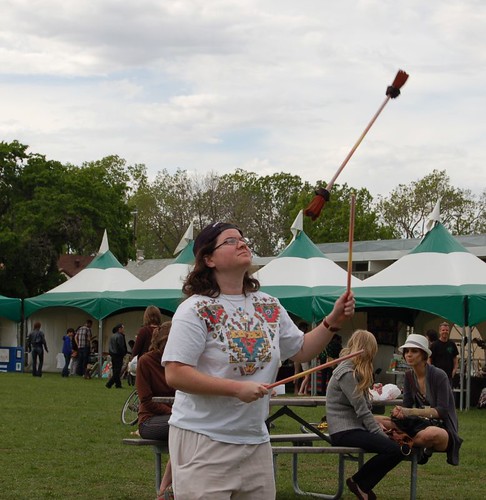
Me Juggling

My name now appears on the Masada 2000 S.H.I.T. List. I have officially arrived.

Now, most of you are scratching your heads wondering, "What on Earth is the Masada 2000 S.H.I.T. List?" The list of over 8000 names (and counting) is compiled by the people behind the Masada2000.org website, of Jews who are "Self-Hating and/or Israel Threatening" (can you see where they got the S.H.I.T. acronymn from now?).

Organized alphabetically, names include many well-known Jewish people who take a stance against colonial Zionism and support Palestinian rights. People like Norman Finkelstein, Noam Chomsky, Naomi Klein, Ilan Pappe, and even people who are quite moderate and working towards a just world full of peace, like Rabbi Michael Lerner. Even Woody Allen and Roseanne Barr are on the list.

In fact, it's really a Who's Who of the Jews - and now, I am part of it! Just follow this link to get to the 'K' page, and scroll down to find my name. There, you will find several photos of me, an extremely vitriolic ad hominum attack, links to my websites, and a couple of my email addresses.

At first, I was surprised at how much space they gave me. They put more photos of me and more information about myself than almost anyone else (at least on the 'K' page), including Naomi Klein and Henry Kissinger! They certainly must view me as a real threat. Little, old me. Who'da thunk it? Obviously, my activism must be very effective if I am pissing people off.

What also struck me is that these people have nothing really to say against my point of view. They do not engage in critical arguments. Instead, they engage in ad hominum attacks. This is a form of bullying.

That being said, let me address a few of the things said on the site. First of all, yes, I am a stick juggler. They are actually called devil sticks, or flower sticks (if they have tassels). I have been juggling since my last year of university, for exercise and stress relief. I am a huge hit at picnics and children's birthday parties. I have even had offers to perform at carnival-types of events and to teach classes to children as part of physical education.

They refer to me as "plump and unattractive" and that one should feel pity for me. Rather than debating my point of view, they try to discredit me by attacking my looks? What is this - junior high? Does my mother also wear army boots? I am the first one to admit that I am not a piece of calendar art, but to attack someone based on something having nothing to do with the issue at hand is bullying, plain and simple. But I have to say, about the accusation of being 'plump' - I'm not plump! I'm just so awesome, I am supersized!

In fact, much of what is said in their blurb about me resembles comments made about me a while back on YouTube. These were people who were obviously not using their real names or photos and saying thinks about my weight, looks, and perceived sexual orientation. I can't help but think that these people are the ones who need pity, having nothing better to do than troll the Internet stirring up trouble.

The quote that the Masada people used from me does indeed contain a spelling error. However, their website is not exactly error-free. I found several. Now, I do editing work on a per-hour basis and would normally offer to help out with something like this. However, I don't work for projects that promote hatred.

One of the pictures shows me "sucking up" to "an Arab in a kuffiyeh." That was taken at an emergency rally concerning the Gaza Freedom Flotilla that was attacked by the Israeli military in 2010. What more beautiful, peace-inspiring image could there be but of a Jewish woman and an Arab man, side by side, sharing a musical moment? Except, in this case, the man holding my microphone (a mic stand was not available) is not an Arab. He's Persian. Just because someone is brown-skinned and wearing a kuffiyah does not automatically mean the person is an Arab. Generalization, much?

I guess I should not be surprised. Prejudicial views run rampant at Masada. To the people at Masada, Jewish values apparently include sexism. Most of the women mentioned on the list are made fun of for their looks in one way or the other. I did not notice the same treatment being given to the men. However, homophobia and transgender phobia are also prevalent. If someone is gay, lesbian, or transgender, that fact is held against them and in a mocking way. Finally, the site is incredibly racist and Islamophobic. I went to the main page of the site in an attempt to figure out who these people are. It's a good thing I had not recently eaten. The hatred against Muslims is just disgusting. If another website spoke about Jews the way they speak about Muslims, they would be the first to accuse it of anti-Semitism.

Yet ironically, people like the ones behind this site accuse Jews like me of being anti-Semitic and self-hating. They, in fact, are the ones who are anti-Semitic. I have never said anything against public and personally against another Jewish brother or sister. However, this list insults just about every Jewish intellectual, academic, and artist who has made any sort of impact, especially within the last century.

As far as the accusation of being 'self-hating' goes, I like myself just fine. Let's face it - you have to have just a little bit of an ego to get up in front of large groups of people and sing and speak. I am also very proud of being Jewish. I have never hidden my religious identity in any situation and always wear a Star of David or Chai pendant. Although I am no longer Orthodox, I still observe many of the holidays and dietary laws. On the contrary, it is people like the Masada folks who turn others off from Judaism.

This is is currently at over 8000 people and is growing all the time. If the people behind the site would get their heads out of their right-wing extremist asses, they would see that that number speaks for itself - that more and more Jews are speaking out against the actions of the Israeli government and military. We are not anti-Israel in terms of the people or the existence of Israel itself. We just believe that violence begets more violence. Attitudes like the one promoted on the Masada site do nothing to promote a world of peace and justice.

I personally view the people behind the Masada site not only as bullies, but as cowards. Who are they? I see no names, no faces. My name (my real name) and often my image (my real image) is associated with what I put online. I realize I am putting myself out there and expect criticism. Constructive criticism and intelligent debate are welcome. But if the best you have are personal attacks that have nothing to do with my politics, let alone my religion, it reflects worse on you than it does on me.

To be named in the company of so many people I admire is an honour. In fact, I have heard reports that to be included on the Masada 2000 S.H.I.T. list is indeed an achievement, and people have contacted the site to try to get on (where they found contact information, I have no idea). My first reaction was something like, "Yay!" followed by intense laughter. Look that the photo of "evil me" juxtaposed near the one of me juggling.

However, I am not sure when my name was added to the list. In any case, they have missed such up to date information as to my involvement with Independent Jewish Voices, having spoken on the organization's behalf at several recent rallies. I also tweet on behalf of Norman Finkelstein. There are photos of me wearing a kuffiyeh. These people really need to stay up to date. After all, I am apparently so important to them.

Monday, November 19, 2012

Emergency Gaza Rally - A Jewish Perspective

An emergency rally for the people of Gaza was held in Edmonton on November 17. Organized by the Edmonton Coalition Against War & Racism (ECAWAR) and the Palestine Solidarity Network, the rally joined others that have been taking place around the world over the past few days in light of Israeli aggression against Gaza. What else can the world expect - there is an election coming up in Israel, and Netanyahu has to play the big man now, responding with force far times greater than the rockets being fired into Israel. While I certainly don't agree with aggression on either side of this conflict, it is hard for me to understand the concept of Israel's argument of self-defense. When a people who are under an illegal and inhumane blockade rise up in arms against those who put them in that situation, the argument that Israel is defending itself it almost ridiculous.

I was asked to speak on behalf of Independent Jewish Voices as well as sing. Unfortunately, the temperatures were a bit cold to play the guitar outside, so I recited the lyrics to one of my songs about the Middle East conflict called "The Side of Peace." Below is my speech and poem. For a full set of photos from the event, click here. For videos, click here.

Independent Jewish Voices has chapters in eight cities across the country and consists of Canadian Jews from diverse backgrounds who share a strong commitment to social justice and universal human rights, to reclaim the tradition of Jewish support for universal freedoms, human rights, and social justice. In fact, we believe that the broad spectrum of opinion amongst the Jewish population of this country is not reflected by institutions that claim to represent Jewish communities as a whole. We believe that individuals and groups should feel free to express their views on any issue of public concern without incurring accusations of disloyalty and we are compelled to speak out because of the lessons we have learned from our own history.

As such, Independent Jewish Voices condemns Israel’s latest attack on the Palestinians trapped in Gaza by Israel’s illegal blockade. Israel has euphemistically dubbed the operation “Pillar of Defense” (alternately Pillar of Cloud).

However, as one IJV Steering Committee member, Dylan Penner, has pointed out, “Israel’s latest attack on Gaza is not a ‘Pillar of Defense.’ It’s a Pillar of War Crimes, which we have a moral obligation to oppose.” He also goes on to say that, “This latest atrocity is compounded by the fact that, thanks to Israel’s illegal and inhumane blockade, for the people who live in Gaza there is no escape.”

Just look at recent history - four years ago, Israel launched its “Operation Cast Lead” on the Gaza Strip. Over 1400 Palestinians were killed — over a third of whom were innocent women and children. Israel claimed moral righteousness while committing this massacre, but the United Nations later found that Israel committed war crimes and possible crimes against humanity and that “the assault was designed to humiliate and terrorize a civilian population.” Amnesty International concluded that Israel’s aggression amounted to “22 days of death and destruction.”

I am a Canadian-born Jewish woman who believes strongly in the Jewish value of tikkun olam, which means healing or repairing the world. When I see the devastating and inhumane and illegal treatment of the Palestinian people by a government and military supposedly representing my religion and culture, it is with a deeply broken heart.

The actions of the Israeli government and military is antithetical to the true values of Judaism which include compassion, reason, and social justice. It is for these reasons that I cannot support such actions. I find it horribly offensive for any of the brutality in Palestine to be attributed to being in my name – it is not in my name. It tarnishes my religion and culture.

I encourage other Jewish people to really look at the situation objectively and not through the idealized notions of Israel with which many of us were raised. To blindly support a nation and its government because of misplaced nationalistic fervour or perceived ownership based on selective Biblical interpretation is illogical.

Zionism and Judaism are not the same thing. Historically Zionism was opposed by almost all organized branches of Judaism. Even today, not all Jews are Zionists. Actually, Zionism’s strongest cheerleaders today are Christians. So, accusations that anti-Zionism equals anti-Semitism are very much unfounded and merely a way of stirring up trouble towards those people who are critics of Israel.

In fact, there are many Jewish voices from within Israel and around the world who are opposed to the Israeli colonial settlement policy in the Occupied Territories and those voices are getting stronger. Thank you.

The Side of Peace I’ve marched in Gaza rallies
And sung for Arab crowds
Though some of my relations
Think I should not be allowed.
I’m asked why do I do it?
Or if I’m scared at the very least;
The only answer that I have,
Is I’m on the side of Peace.

I always say I’m Jewish,
It’s part of who I am.
So is speaking out
For human rights as best I can.
This conflict is immoral
I want it all to cease
And that is why I take a stand
On the side of Peace.

When innocent civilians
Are killed day after day
By military massacres
I have the right to say
Collective punishment is wrong
As the death tolls increase.
The only way to save lives
Is on the side of Peace.

Unlike so many others
I can’t support a nation
When it’s so horrific towards
Part of the population
Yes, the leaders are not innocent
But the children are, indeed
So are all the others who
Are on the side of Peace.

It’s easy to be silent
Or toe the party line
Complicity is for cowards
Who are part of the crime.
I will never be accused
Of groveling on my knees
I stand with my conscience
On the side of Peace.

© 2009 Paula E. Kirman

Wednesday, September 12, 2012

Dis-Organizing Religion

When I first became involved with a church (in fact, one which I planted nearly a decade ago), I often would encounter Christians who were burned out on church. They still believed in God, still read their Bibles, but were frustrated with the organizational structure of houses of worship because of the focus on money

In most Protestant denominations (yes, I am Jewish, and the "church" in question was a fusion of both Jewish and Christian belief, but for the sake of illustration let's just stick with the Evangelical Protestant model) there is a pastor who is accountable to a board who is made up of congregational members. There is a set of bylaw, often referred to as a "Constitution" which is like a code of conduct for everyone involved, outlines the church's mission, and sets accountability. It is necessary to have such a document for the purposes of gaining charitable status with the Canadian government.

The pastor is paid from the tithes collected from the congregation - the proportion of the tithes set aside for staff salaries is usually outlined in the Constitution, with the rest of the money going for things like rent and other administrative costs.

Being a pastor is an incredibly stressful job physically, emotionally, and spiritually. To be in full-time ministry is not feasible in today's society unless you are getting paid. In addition, your life (as well as those of your family members) is constantly held up to scrutiny. The same holds true for many in church leadership like elders and deacons. I believe this is a reason why there is so much "moral failure" amongst church leaders - they simply cracked under the pressure, grabbed the secretary, and headed for the broom closet. I am over-simplifying, but I think you know what I am getting at.

I also know a number of people who fled churches and synagogues, becoming involved with home fellowships where they studied the Bible, sang, and shared. People felt more free to talk about issues that concerned them, they got to connect with the others more intimately (I never understood why people would want to attend "Megachurches" where the only people you get to know, if any, are in whatever small group you choose to take part in), and, best of all, no one's hands are in anyone's pockets.

Tithing is Scriptural (Leviticus 27:30; Malachi 3:9) in terms of the amount and also to give joyfully. Most churches harp on the amount and not the joyful part. Another aspect of tithing not spoken of as often is the fact that you give your 10% *after* you have paid your rent, groceries, and other essential bills. It's net, not gross.

But when an institution that is supposed to focus on spirituality becomes driven by money, other messages get lost also. While sermon after sermon harp on issues like homosexuality or abortion, other issues laid out by the Bible are rarely, if ever, touched upon. When was the last time you heard a sermon about business people who lie in order to score a deal? Or CEOs of corporations who profit from the labour of others? Or government leaders who are dishonest with their constituents and engage in foreign policy that leads to the murders of millions overseas? Probably not recently.

I'll tell you why not: because church leadership cannot afford to risk alienating the rich business people and Conservative government supporters who may be in the congregation. People who will pick up and take themselves (and their tithes) elsewhere. When a church is run as a business, business decisions have to be made that are in its best interests, and this filters down to the messages that are presented.

It should thus be no surprise that faith and politics are so intertwined. The US is heading towards an election, and all kinds of messages are coming from both Christian and Jewish leaders about the need to elect the "right" candidate (no pun intended). A government that supports corporations and big business and imperialistic foreign policy serves those who benefit from it the best (the rich), and the more rich people in a congregation, the richer the church will be.

Mega-churches (and whatever the Jewish synagogue equivalent is) are really corporations unto themselves operating under the guise of spirituality. Smaller churches also are affected by similar issues (rich congregants = more tithes) although at least there is some more accountability on the parts of everyone involved, since more people within the church itself are likely to know each other (which leads to another problem of everyone knowing everyone else's business, but I digress).

Because of all of these issues, I have found myself really wanting to connect spiritually in a house environment, or even just amongst two or three others, or even one on one, depending on the situation. Why does worship and study have to be in a set place and time? Where does it say in the Bible that we have to be in a structured church with a paid leader? No one paid Jesus. Instead, He paid in the end. And that should be the ultimate lesson to us all.

Sunday, December 27, 2009

Home For the Holidays

The last week has been filled with more holiday goodness. A couple of days after Chanukah ended, my friend Tamara hosted a party at her home, featuring a lesson in making latkes (potato pancakes). I met Tamara on Twitter, and she invited several people in the local Twitter community to come. We had a really great time hanging out. Here is a look.

Christmas fell on a Friday this year, which means Shabbat dinner with my folks. I was invited to Christmas dinner by my friend Kylee, which unfortunately I had to decline as a result. Kylee is one of my volunteers at Boyle McCauley News, where she writes and helps deliver the paper. Her father is also co-chair of the board - which makes him technically my boss. Technically. He's one of my best friends and I've gotten close with others in his family as a result. It meant the world to me that I was asked to join the family on Christmas, even though I could not go.

Speaking of Boyle McCauley News, Boxing Day saw me volunteering at a casino for the McCauley Community League. The League helps the paper with its casino, so we try to return the favour. When I wasn't running chips, I was relaxing in the volunteer lounge watching movies (Australia and Mamma Mia) and eating free food. The restaurant in the Yellowhead Casino really rocks. The prime rib was superb!

I worked off some of the calories by taking a stroll down Candy Cane Lane Saturday evening. Some of the houses were great, but it sure isn't like it was when I was a kid. Still, there was a lot to enjoy. Here is my photo set.

This afternoon, I headed to Brewsters for Torah on Tap. It is basically a schmooze with the rabbis from the Reform and Conservative congregations, on a specific topic and its relation to Jewish law. Today's discussion was on mitzvot, which are commandments. I kept quiet for most of it (yes, I can actually be quiet sometimes, especially when I am in a situation where I don't know a lot of people), but find these sorts of discussions fascinating. I expect I will attend again.

Thursday, December 17, 2009

A Cold Chanukah

We got hit by a huge cold snap over the weekend - at one point, Edmonton was the second coldest place on Earth, beaten out by some remote location in Siberia! Here is a look at what some of the windows in my house looked like: one and two. Still, I managed to head out and enjoy some holiday parties and events.

The Jewish Festival of Light, Chanukah, began last Friday evening. On Saturday, I went to a Chanukah celebration held at B'nai Chayim, a church that celebrates the Jewish roots of Christianity. The latkes (potato pancakes) served right out of the oil were delicious. Here are some photos from the party and their morning service. As well, I recently took part in a re-design of the congregation's website, along with the help of John.

The following day, I ventured out (with assistance!) to the annual menorah lighting at the Alberta Legislature. Speeches were made by Premier Ed Stelmach (yes, I behaved myself), Mayor Mandel, and other Conservative political types, as well as Rabbi Ari Drelich who organizes the event. Then, we headed out into the -35 darkness and watched the menorah be lit, as Rabbi Drelich, Premier Stelmach, and another rabbi went up in a lift. Here are some photos and the coverage from iNews880.

Since we were there anyways, despite the cold we decided to take some photos of the Christmas lights decorating the Legislature grounds. Here are my results.

Then, it was off to Temple Beth Ora's Chanukah celebration. The program featured songs, lighting the menorah, and a dramatic presentation. Here are some photos.

Chanukah is not over yet. We're lighting the menorah every evening at home. Chag sameach!

Thursday, December 03, 2009

He Said, She Said: Interfaith Relationships

Several weeks ago I had the pleasure of meeting one of my long-term Twitter contacts in person, @Sirthinks. John, his name in the real world, showed up with his Flickr photo group at a rally where I was singing (totally by coincidence, I have been told). Apparently, our meeting prompted John to check out some of my work online, including the two articles I have written about interfaith relationships: Single Jewish Female: Dating Within the Faith and Small Community, Big Problems: What's a Jewish Girl to Do?.

John had some very strong opinions about what I wrote, and we decided it would be a great idea if we did a "he said/she said" exchange about interfaith romance on his blog. He and I went back and forth for a while, adding our thoughts to the same post, then opened up the post to comments from others. Here is the post: Tradition v. The Heart v. Expectation.

When our thoughts started winding down, we each wrote separate summary posts. Here is John's: On compromise and the devil's advocate. And, here is mine: Straight From the Heart: Traditions and Love.

As readers can see, John and I are both very opinionated people. I am not sure that we see eye to eye on everything (in fact, Ia m sure we don't), but this exchange was definitely worth having as it caused both of us to reflect on our values and beliefs.