Showing posts with label social media. Show all posts

Monday, December 02, 2019

Our Digital Future, C'est Ici

On November 29 and 30, Studio 96 became home for about 30 young people, mostly in their late teens and early 20s, who took part in a 24-hour “Thinkathon.”

“Our Digital Future, C'est Ici” was organized by the Goethe-Institut Montreal, as well as the Goethe-Institut Toronto, Edmonton's NextGen, European Union in Canada, and the CJD NDG, a non-profit organization in Montreal that helps young people enter the job market.

The Edmonton event was the second in a series of Thinkathons in six Canadian and six European cities between now and the end of 2020. The project offers young citizens (18-30) an open, inclusive platform for a debate on our digital futures. During the 24 hours, participants co-created videos and social media campaigns, as well as recommendations, for Canadian and European politicians. The work took place both on-site and online, connecting with a Thinkathon happening at the same time in Milan, Italy.

The first Thinkathon took place in October in Montreal and Brussels, Belgium on the topic of Digital Citizenship 4.0.

I was especially excited to be asked to be one of the guest expert speakers at the Edmonton event. I was asked to speak because of my work in community and digital media, as well as community organizing. My topics were online hate, hate groups, and bullying in the digital age, particularly how to deal with it when encountered online and how to protect themselves (and each other) from such behaviours. I was also asked lots of questions about the current state of the media, and how the digital age has changed how we get our information and how we interact with social media and the Internet.

After introducing myself and explaining my work (focusing in particular on documenting social movements at RadicalCitizenMedia.com), I gave a very general overview on online hate and bullying. Some of my major talking points included:

  • The digital age can give anyone a public platform, which can be good - it means people who are marginalized but have access to electronics can have a voice - but there is a dark side.
  • People can feel emboldened behind a keyboard, and can even be anonymous, and say things they would never say in person.
  • Online media can also make recruiting people for hate groups easier, because people who are lonely, disenfranchised, vulnerable can be easier to reach.
  • Arguing with haters doesn't work. It just amplifies whatever was posted.
  • Block, delete, report, repeat. If reported enough, person/group may get banned from the service. They may come back with a different name, so be vigilant and keep reporting.
  • Same for bullying: report behaviour, and support the person being bullied. Send them public and private words of support.
  • Protect yourself: keep social media locked down to friends only, be particular about who you accept to friend/follow you, use a false name, don't use a photo of yourself as a profile picture.
  • Doxxing = posting a person's photo and personal information online with the intent of causing harassment. If you are doxxed report it to the online service, to authorities. Keep a record of all harassing calls, emails, posts.

    The questions and comments that followed were excellent. Here is a summary of the outcomes of those questions and comments:

  • While "block, delete, report, repeat" might seem like a band-aid solution, it's the first step. The goal is to get the groups/individuals off the Internet. This has been achieved through continuous reporting, but also posting about the people/group and their behaviour on public platforms, including screenshots/quotes.
  • Emotions cannot be banned. But if someone is posting harmful, inappropriate things, they have to be stopped. It would be great to channel that energy into something positive, but that usually comes from a person's work on themself and the intervention of the people around them. They also may not see their actions/words/ideology as negative. They think they are standing up for their country, their culture, or whatever. It's very difficult to have a rational discussion with someone of that mindset.
  • There are no laws specifically against doxxing (that I am aware of), but there are laws against criminal harassment. Document everything.
  • Social media has changed the way people do community organizing and activism, in terms of organizing events but also how they participate, to capture very visual or vocal multimedia posts to use on social media.
  • Social media has grown in importance in terms of allowing people to become citizen journalists, especially now when traditional media is dwindling.
  • It's important to be positive, even when social media is very sad and dark. Post about people in your community doing things to make the world a better place. Don't engage with the negativity if it is hate speech or trolls - work to get rid of it as described above, and add posts that are more positive in nature to your social media.
  • What should be done about "cancel culture" and/or "call-out culture"? If a person has made a mistake or done something inappropriate and you have access to them, talk to them first. Calling out as a first step is generally reserved for people to whom one doesn't have access, such as celebrities being called out as part of the #MeToo movement. Every situation is different and you need to use your own judgement, but in general, calling out should be a last resort.
  • How has documenting local activism changed since I began in 2005? When I started, I was one of the few doing it, but now since so many people have smartphones, lots of people are taking photos and shooting video and posting on social media.

    More information about the Thinkathons is here.
  • Saturday, February 03, 2018

    Documenting Activism at International Week

    I was invited to present Documenting Activism during the University of Alberta’s International Week 2018. I have posted my notes and a video of the presentation at my main website, Words, Pictures, Music.

    Wednesday, February 08, 2017

    Documenting Social Movements - John Humphrey Centre Peacebuilders Talk

    I was invited to address the Peacebuilders group of the John Humphrey Centre for Peace and Human Rights at their meeting on February 7, to discuss documenting social movements to further discussion about peace and non-violence. Here is a video of my talk, as well as my notes.
    1. Why did you start documenting events in your city?

    I showed up to my first peace rally in September of 2005 and asked permission to take photos. I just thought it might be an interesting thing to do. I posted the photos later on, on a blog I had, and the reaction to them online was so huge, the server crashed. I realized that I might be on to something – that no one at that point was documenting the local activist scene and that there was a demand for it – a desire to see photos from events afterwards. I got a better website with more server space, and began to hone my skills in photography and social media, and a short time later, videography. I document through photography and videos, and share my work using social media.

    1. Why did you think it is important?

    The importance of documentation has several facets. First of all, it is capturing history, perhaps a part of Edmonton's history that is not and has not been widely examined. It keeps a record of what happened, when, and why. It creates something tangible that can be shared with others, both locally and elsewhere, and perhaps even help to form connections between organizations and individuals. I also view what I do as having an artistic element to it – art and activism are very closely connected in my beliefs, as both communicate messages in visual ways. Also, documenting visually, unless someone intentionally sets about using photoshop or some other program in nefarious ways, are ways of presenting the truth of what happens. For example, I recently videoed Jane Fonda's talk during a panel discussion on pipelines. A number of people expressed their dismay to local media that a celebrity should come up here and be disrespectful, and were basically criticizing what she said, without actually listening to what she said. I gave them that opportunity.

    1. What are your favourite platforms on social media to use? Why?

    I use YouTube and Flickr for videos and photos, respectively. I find them both intuitive to use and make my work easy to share. I post my work, then share it on Twitter and Facebook. The sharing/retweeting capacities of these social media platforms help spread my work to a wide number of people in a relatively short period of time. I have been using Instagram more and more, because I like how it enables someone to take a photo then send it out to a number of social media platforms at once. For blogging and simple websites, I really like Wordpress because it is so intuitive, but I have also used Blogger.

    1. What kinds of conversations have started due to your documentation?

    There have been conversations about the efficacy of the use of social media when it comes to activism. There is agreement about it being a great way to get messages out, but also it's important to be cautious: such as, not accepting any and all friend requests, being careful about sharing personal information, and issues of privacy and permission (photographing people in public places taking part in public events in fair game, but there may be times when it would be appropriate to ask permission). And there have been conversations about the subject matter itself, discussing different sides of the issues, which is really what we want to do: foster discussion about issues concerning conflict and human rights.

    1. If you could provide 2 examples of your documentation (mini case studies) that have greatly impacted the work that you do?

    a) In June of 2015 Justin Trudeau was in Edmonton to help launch the campaign of Amarjeet Sohi, who was running for MP as a Liberal in Edmonton-Mill Woods (he was subsequently elected). The Edmonton Coalition Against War and Racism, of which I am a part, was organizing a series of pickets against Bill C-51, which the Liberals voted in favour of, with the promise that if elected, they would revise some of the more problematic parts of the bill (we're still waiting for this to happen). All of the media was inside the banquet hall – except me. I was filming the protest. All of a sudden, I heard a lot of screaming coming from behind me, and I turned around, and there was Justin Trudeau himself. He engaged in an argument with Peggy Morton, and ECAWAR organizer, and I got the whole thing on video and it went viral across the country – I was doing interviews about it with media outlets, and that video is still doing well. This experience really hit home to me the importance of what I was doing – no one else captured this moment – and also how a large part of doing this job I am doing is simply showing up and being in the right place at the right time.

    b) I was a co-organizer of the recent Women's March on Washington – Edmonton Solidarity Event on January 21. If anything shows the power of social media, it is this. Combined with the international media coverage the sister marches were getting (the main march was in Washington, of course), our event page, Twitter, and Instagram went viral. Documenting this was also important to us, so I was doing triple duty as an emcee, videographer, and photographer (we did have an official photographer as well). We saw the numbers on Facebook getting bigger and bigger up until the day itself, when over 4000 people packed the north side of the Legislature grounds. Myself and one of the other co-organizers, have decided to try to keep the momentum created by the march going and are using social media with a new Facebook page, new Twitter and Instagram accounts (@wmwyeg), and a new website (wmwyeg.org).

    1. Do you think the voices of everyday citizens through your documentation have impacted the community? In what do you think the community has been impacted?

    My documentation gives every day citizens a voice and a platform they may not otherwise have had. Mainstream media often does not cover progressive and activist events at great length, if at all. I am putting up entire speeches or at least more than just 30-second soundbites. This also impacts the community in that it creates resources for future actions and the ability to start dialogues on the different issues presented.

    1. How important is the freedom of speech for you in Canada?

    For all of our protests and rallies, I do acknowledge that we are lucky to be living in a country like Canada where there is freedom of speech. I think that what I am doing amplifies that – by taking words and actions, and bringing them to different and wider audiences.

    1. Any words of advice for people who are wanting to start creating dialogues or using social media as a platform to create a more peaceful and respectful community?

    Here are some best practices I always encourage. I already mentioned being careful about accepting friend requests and giving out too much personal information.

    Photos/Videos
    • Seems like common sense: make sure batteries in phone and cameras are charged.
    • Carry charger and battery packs for phones.
    • Some camera batteries are proprietary; have a spare (if economical) and/or make sure it is charged in advance.
    Instagram
    • Good descriptions
    • Lots of hashtags
    • Settings to share on other social media like FB and Twitter
    Photos: Facebook
    • Don't tag people who are not in photos. Pet peeve of many; good way to get de-friended.
    • Respect it when people don't want to be tagged. Easier now that people can remove tags themselves.
    Writing/Blogging

    • Keywords
    • Have someone else edit your work
    • Fact check
    • Share links to your work on social media
    • Keep your emotions in check: say it and forget it, write it and regret it.

    Sunday, October 19, 2014

    Together, Creating a Better World: Workshop Notes

    Together, Creating a Better World - Workshop

    Together, Creating a Better World is the title of a handbook (written by long-time activist Jim Gurnett) and more recently, a workshop aimed at women who are new to community organizing. The event was organized by the same group responsible for Daughters Day and took place on October 18 at the Stanley A. Milner branch of the Edmonton Public Library. Four women presented about different aspects of community organizing to close to 30 women from a variety of backgrounds. First, we heard about identifying a social issue and analyzing it. The next presenter spoke about mobilizing the community around a social issue. Then, we learned about organizing a good event on a social issue. I was the final presenter, and spoke about communications: how to effectively get the word out about an event or working group on a particular cause, and documenting events, with an emphasis on the use of social media. Below are my notes from the session, with the hope they will be of value to women and basically anyone who is new to activism and using the technology that is available to organize, promote, and document citizen engagement.


    Introduction
    About me:
  • Freelance communications professional who works in traditional and new media.
  • Activist, organizer in peace movement. With Edmonton Coalition Against War & Racism (ECAWAR).
  • For almost a decade been documenting the local activist community at RadicalCitizenMedia.com
  • Connect with me on Facebook (search my name - personal and music page); Twitter.

    Why Social Media?
  • Traditional media still has its place: letters to the editor can be effective as well as placing free notices in listings in newspapers.
  • Social media more far-reaching to inform, document, and express concerning issues of social justice.
  • Benefits: Free (or low-cost); low learning curve; relatively simple.
  • Barriers: Not everyone can afford to have access to a computer or smartphone. Can be a classist issue. Not everyone is on social media - can be a generational thing where people are not as used to using a cell phone or computer. Lanaguge if English is not your first language.
  • Solutions: Libraries and some organizations have computers that are free to use. Even homeless people can sign up for an email account. You can post in your native language and reach people in your culture that way. Otherwise, your English does not have to be perfect and there is the opportunity to improve English by using it online.
  • Concerns: Privacy issues: don't post anything you would not feel comfortable with the whole world knowing. Don't post very personal details online. Corporate data mining - the price to pay for using a free service.
  • Smartphones can equal safety in activism: If something goes wrong, someone can photograph or film, and send to social media in real time.

    Integrated Use
  • Overview of the use of Facebook, Twitter, Flickr, YouTube, Instagram
  • Hashtags: mark Tweets to make searches specific, eg. #yeg for Edmonton. Create a hashtag for your event, eg. #DD2014yeg for Daughters Day 2014.
  • Facebook events: invite friends, get them to invite friends, etc.
  • Free blogging sites: Wordpress, Blogger
  • RadicalCitizenMedia.com: links up photos and videos into a blog.
  • Post links to photo albums, events on Twitter.
  • You might want to have a communications subcommittee where someone photographs, and other films, another posts online, due to workload.

    Success Stories
  • Occupy, Idle No More, and recent Palestine solidarity
  • Social media is becoming more accessible and commonly used.
  • Specific social media campaigns, like taking a selfie holding a sign with a message, and posting on Facebook or Twitter.

    Discussion
  • How many of you are familiar with Twitter and Facebook?
  • Have you ever used social media to organize? If so, for what?
  • What concerns do you have about using social media?

    Questions
    This portion of the workshop was open to questions. Here are some of my comments in response to the excellent questions I was asked:
  • Documenting events can be beneficial if you seek future funding, as you have proof of your previous event and also provide the opportunity for sponsors to be recognized through your photos, etc.
  • If you are photographing a public event in a public space, you don't need direct consent from everyone in attendance to take pictures and post them. You can announce, as a courtesy, that you are filming/photographing and say if anyone has a problem with appearing in photos to let you know. Disclaimer: This is not legal advice. This is from my own experience and what I know of these situations.
  • Thursday, November 08, 2012

    Social Media and Social Responsibility - Salvos Prelorentzos Peace Award

    Salvos Prelorentzos Peace Awards 2012 by raise my voice

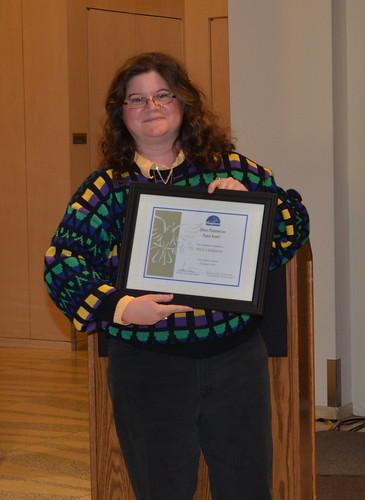
    On November 6, 2012 I received the Salvos Prelorentzos Peace Award from Project Ploughshares at City Hall. In its 17th year, the award is given annually to someone in Edmonton who has worked towards the goals of peace and social justice but who has not yet been formally recognized for their work. I was chosen for my pioneering efforts in documenting the local activist scene and using social media and other online tools to share and connect. This is my acceptance speech. For a full set of photos, click here. For all of the videos, here is the playlist.

    Social Media and Social Responsibility
    Salvos Prelorentzos Award Acceptance Speech
    Paula Kirman
    November 6, 2012


    When Jim Gurnett called me back in January to inform me that I had been chosen as this year’s recipient, I was at a loss for words – and for someone like myself who makes a living with words, that is indeed very rare. Then, I found myself in a similar situation when I sat down to write my words of acceptance.

    So, let me begin by giving thanks. Thank you to Project Ploughshares for making this event possible. Thank you to the award’s organizing committee for selecting me, especially to Alison Scott-Prelorentzos for honouring her late husband in this manner. Thank you to David Climenhaga for speaking tonight, and to Terry Morrison for gracing us with her wonderful music. Congratulations to Mr. Kalia for his lifetime service award. And thank you to all of you for coming out this evening. It really does mean a lot to me, more than I could express.

    I am very honoured and humbled to have been chosen as this year’s recipient, especially when I reflect upon the incredible people and organizations who stood up here in past years, many of whom I am privileged to call my friends and my brothers and sisters in our common struggle to bring about a world of peace and justice.

    Now, I will tell you a bit about myself. As a child, I made an impassioned plea to my parents for two things: a camera and a guitar. I am fortunate that my parents indulged me, although I have to admit that the guitar took a little more convincing.

    Communication is what I do professionally, and there is a need for communication about peace and matters of social justice between organizations, individuals, and the world. We have the technology at our fingertips to do this. I am fortunate to be part of a generation to embrace social media as well as the technological gadgets that make archiving and sharing possible.

    Then, it was just a matter of connecting with the local peace community – something I did not know existed until I purposely went about looking for it. When I found it, I showed up at a peace rally with a digital camera and started taking pictures. At that time, I was really the only person taking pictures at these sorts of events, and then the first to get the images online to be shared.

    When I saw the possibilities to really show the rest of Edmonton and beyond that the city really does have an active, engaged peace community, this expanded into acquiring a video camera, learning to edit film footage, as well as increasing the number of social networks upon which I share my work while getting into more sophisticated forms of blogging and website design.

    I am now so enthusiastic to see others showing up to events with cameras and getting online and sharing and commenting. Those of us who are privileged enough to be able to access and use technology have a choice to use developments like social media for the good of society. It gives us the opportunity to become independent citizen journalists and present our perspectives in a widely public forum but in a way that is very real with a human element.

    Equally important to presenting and showcasing the city’s activist movement is sustaining it. In order to make sure the city has a peace movement that stays active, it has to stay relevant and attract younger people. Love it or hate it, the so-called “new media” is how to make this happen. When I do things like get Project Ploughshares onto Facebook and reviving the website for the Edmonton Coalition Against War and Racism it is with a sense of excitement for the future.

    Now, about that guitar - when I got involved in the local peace movement, it was a natural transition to write songs with social meaning. I was, after all, raised on a steady diet of Joan Baez and Bob Dylan. It was also a way of being more directly involved with events rather than always just standing on the sidelines with a camera. And again, thanks to social media, I’ve been able to reach an audience far beyond just the people who show up at the events.

    At the same time, thanks to social media, my activism has been very public and that is not without its challenges, personally and professionally. But like I said earlier, we have the tools at our fingertips to share and build our movement. It comes down to a matter of choice, and I have considered working towards peace to be a personal responsibility.

    And on that note, I will end with the chorus of the song I wrote about choosing to stand up for peace in the face of resistance, called “Walls”:

    I can’t sit on the fence anymore
    When I have to choose between peace and war
    And object to oppression where it arises
    No matter what else it is disguised as

    I hope that we can all make similar choices in our lives. Thank you.

    Thursday, June 16, 2011

    Social Media and Advocacy in the Inner City

    On Wednesday, June 15, I had the privilege of being invited to speak at the inner city discussion group of the Edmonton Inner City Health Research and Education Network (EICHREN). The topic of the evening was "Social Media and Advocacy," and the organizers felt that my work with Boyle McCauley News, my strong online presence (particularly on Facebook and Twitter), and passion for social causes made me an ideal person to share my knowledge.

    Most of the people at the meeting were young doctors, medical students, nurses, and people involved in inner city organizations such as the Boyle McCauley Health Centre and George Spady Centre. They wanted to know how effective social media was and how they could use it in areas of advocacy with which they are involved, such as harm reduction, safe injection sites, and needle exchange programs. The group was split pretty much down the middle in terms of those who were familiar with social media, and those who had no idea how Twitter even worked.

    I talked a little but about how I gave Boyle McCauley News a presence on social media and how such methods can be used for informing one's contact base of events and information. Besides some technical questions about how it all actually works, one of the main concerns was access. I pointed out that access to computers, as well as literacy (both towards computers and in the traditional sense) could be issues for certain groups in the inner city, such as the homeless. People who are not homeless but lower income may not own a computer. Some discussion ensued about allowing access to the Internet at various agencies, as it was felt that if the technology was available and a person was able to use it, they likely would.

    Other discussion ensued about the efficacy of using social media over traditional kinds of advocacy (such as those done in person or writing physical letters as opposed to emails), citing Malcolm Gladwell's article in the New Yorker Small Change: Why the Revolution Will Not Be Tweeted.

    Overall, EICHREN is a group that is just gaining momentum. How it will use social media and for what purposes are yet to be established. It already has a Twitter account. The fact that the people involved are interested in social media and asking the right questions shows promise for what is potentially a strong push for advocacy of inner city health issues.

    Friday, January 07, 2011

    When You're Strange - A View from the Inside

    Several of my friends on Twitter have committed to a monthly blogging schedule based on a specific theme. January's theme is racism and/or discrimination. At first I felt this was a topic to which I could add no real insight. After all, I am not a member of a visible minority, and as such have never encountered racism. I am Jewish, but have been fortunate enough not to have had to deal with anti-Semitism, at least not overtly.

    This got me thinking that when racism or discrimination is the topic on the table, we often think of it in terms of what members of one group does to another. There is always some sort of cultural, religious, or racism differentiation. However, my own experiences have shown that discrimination can happen within the same ethnic group.

    I grew up in a fairly traditional Orthodox Jewish home. As a result, it was always assumed that when my brother and I became of school age, we would attend the local Talmud Torah day school. As my older brother approached the time to register for grade one, it became evident this would not be the case. In those days, there was no transportation provided for children who needed a ride, despite my parents being told otherwise. My father, a professor at the University of Alberta, taught 8 a.m. classes and would not have been able to drive my brother to school every day. My parents desperately tried to work out car-pooling and ride share agreements with other Jewish families in our area, but to no avail.

    Finally, it was time to register my brother for school. My parents enrolled him in the public school a couple of blocks away, and that is where he and then I attended for our elementary and junior high years. I was the only Jewish child in my class for the first six years of my school career, and I never felt strange. I knew I had customs and traditions that were different from the other kids, but it did not bother me at that time. My father often came to my classroom to make presentations about the Jewish holidays and share some ethnic food treats. At the same time, I enjoyed taking part in Christmas decorating and concerts. Yes, there were a few things I had to skip, like birthday parties on Saturdays (the Sabbath) and the annual hamburger barbecue (I ate no non-kosher meat at that time), but to put it in the vernacular, it was all good.

    Then came junior high.

    The Talmud Torah only went up to grade six back then. It was a feeder school for the school I attended, so when junior high came around so did a lot of Jewish kids. I was very excited that for the first time I would get to hang out with other people of my tribe. I would finally have Jewish friends! Or so I thought.

    It broke my heart when the other Jewish kids would not accept me because I did not go to their school. They would not even believe that I was really Jewish. The irony is that I was still religiously observant at that time, while they obviously weren't given their dietary and weekend habits. I was severely taunted verbally by many of them, and physically by one in particular. I was an outsider in my own cultural group.

    To this day, I still feel somewhat like an outsider in the Jewish community. I do have some Jewish friends and am involved in a few community activities, but I don't really consider the Jewish community to be mine. The community is very small and homogeneous, and when you are someone who has views that don't fit with the mainstream, you really stick out. It is almost as if one's Jewish identity is determined by outside forces like what school you went to, what family you're from, how much money you have, and your political beliefs.

    While I still bear some of the scars of my youth, I have come to terms with myself and my identity. Developing the courage to stand up in the face of adversity I believe is one reason I became a social activist. It is why I cringe when I see others (either here or abroad) mistreated by a system, a nation, or a paradigm of thought. This has led me down some interesting and unusual paths both as a Jew and in general. Pressure and heat, when applied correctly, can create newness and beauty. If faced with a choice of an easy route or a struggle, I choose the struggle.


    Related Posts:
    Blog Group Topic #1: Racism/Discrimination/Stereotypes by @lindork
    Discrimination and Helplessness by @JenBanksYEG
    The Double Meaning by @TamaraStecyk
    Racism, would it cease to exist without...? by @sirthinks
    It's Not Me, It's You by @Joanna_Farley

    Friday, October 08, 2010

    Social Media and Language

    The growth of the use of social media has changed the way some people speak and write. In some cases, new words have been entirely invented to reflect the use of a particular service, like Twitter. When I post to Twitter, I am "tweeting" and my post is a "tweet." Facebooking can refer to anything from updating one's status to adding friends.

    Which leads to the next category of existing words that have been changed in meaning or usage. "Friend" can now be used as a verb ("I friended so-and-so on Facebook"). "Followers" may not mean there are creepy people following us around, but how many people are reading our tweets and blog posts.

    Then there are abbreviations to add the illusion of laughter like the ubiquitous "LOL" and "ROTFL" (and countless variations) in addition to emoticons that are constructed by punctuation in the shape of a smiling or frowning face (again, with many variations to account for facial hair, glasses, and other emotions).

    While some perhaps shudder at these inventions, one should not label such changes as disintegration necessarily. Change can be just that - reflections of the times. As society changes, so does its language. We don't speak Victorian English anymore, and there are numerous words that have changed meanings or connotations over time. For example, although it is technically correct, few people still use the term "gay" to mean "happy."

    However, where there needs to be concern is related to the actual time and place of usage. It is appropriate to use these words when discussing and using social media (or other electronic forms of communication like texting and e-mail). If someone actually starts referring to making friends in real life as "friending" people, maybe he or she isn't really spending enough time away from the computer. As well, when people start saying things like "LOL" and "smiley face" during in-person (or telephone) speech, then there is potentially a problem when someone cannot express him or herself properly without the use of such enhancements.

    Which begs the question of whether this is just laziness on the speaker's part or representative of an erosion of language. As someone with a wide social network both online and offline, I don't think such situations as described in the above paragraph are widespread yet. Verbal skills already vary from person to person based on culture (is English their first language?), level of education, and cognitive ability (which includes everything from general intelligence to whether or not a person has a developmental disability or brain damage).

    How someone uses the language of social media will depend on how much time a person spends with social media and how important social media is to that person. Someone who is only a casual user of social media will of course not be speaking of tweets and friending the way someone who uses it for hours every day will. Also, younger people growing up in a culture of social media, who have not known a world without it (or at least were too young to remember) could potentially be more likely to do the verbal LOL-ing.

    Another consideration apart from speech is written language. So far, I have not seen too many smilies or LOLs work their way into newspapers or magazines. I also don't think many teachers or professors would accept such things in a term paper. Unless, of course, the paper is about social media. :-) (Sorry, I could not resist.)

    Still, we likely won't know how social media ultimately affects language on a long-term basis because it is so relatively new. Like MySpace (which is now mostly used by bands), Twitter and Facebook may eventually go out of vogue to be replaced by other services with their own vocabularies. In the meantime, I don't think the English language is suffering too much.

    Tuesday, April 21, 2009

    Web 2.0 for Activists and Community Organizers

    These are the notes I used for my presentation during the breakout session/workshop, "Using the New Media" during Public Interest Alberta's third annual advocacy conference, "Beyond Band Aids and Bailouts: Public Solutions in Critical Times." My actual presentation stayed a bit from what I prepared, as I found myself faced with a number of questions concerning the use of Twitter. As a result, I did not spend as much time on the pros and cons of Web 2.0.


    Web 2.0 for Activists and Community Organizers


    Introduction
    I’m Paula Kirman and for the past several years I have been documenting the local activist community through photos, videos, and writing. In doing this, I have been utilizing several Web 2.0 applications and platforms to both organize events and publish content afterwards.

    Facebook
    How many of you are on Facebook? Facebook is popular with activists for good reason. You can create or join groups for organizations and causes. You can organize events by creating a page for the event with all of the details and then inviting people on your friends list. Using one message, you can contact everyone on an event or in a group to inform them of changes or other relevant information. Facebook also allows one to upload photos, videos, and write notes (which are similar to blog posts), but do not have the space allotments, ability to organize, or audience potential of other social networking sites that specialize in these areas. Which brings me to . . .

    YouTube

    YouTube allows user to upload videos on practically any subject matter. YouTube converts the video file into the proper format for streaming, hosts it indefinitely, and allows the video to be shared with a user’s subscriber and friends list. Videos typically have to be shorter than ten minutes, so longer videos have to be divided into parts.

    Flickr
    Flickr is a photo sharing website owned by Yahoo. Users can organize photos into sets (based on date or event) and sets can be organized into collections (based on themes, like peace marches, for example). There is an upload limit and limit to the number of sets for free users. Site members have unlimited use of the site for a reasonable fee (something like $25 per year Canadian). You can have a contact list made up of other Flickr users and be notified when they upload new content.

    Blogging
    Blogging allows anyone, anywhere to be a citizen journalist. You can integrate your photos and videos from Flickr or YouTube into your blog, allowing one to write a full report of an event with visuals. After I upload my photos and videos I will often blog about an event, using embedded visuals or linking to the specific videos or photo sets.

    Twitter
    Twitter is a microblog. In 140 characters or less, you answer the question: What are you doing? In some ways, it is like the Facebook status update. However, users are taking Twitter to another level by posting short news items, links to articles, and other kinds of timely information that can come across well in a soundbite. I often post direct links to videos, images, articles, and blog posts.

    Benefits
    ·By using YouTube and Flickr I reach a much broader audience than simply hosting videos and photos on my own website.

    ·Web 2.0 is cost effective for the average person, because most of the applications are free, or have a very small fee. Videos and images take up a lot of bandwidth and private hosting can get expensive.

    ·YouTube and Flickr allow users to directly post videos and photos to their blogs. The image or video can be embedded directly on the blog post.

    ·The ability for YouTube, Flickr, Twitter, and most blogs to have content uploaded directly from one’s cell phone or portable device allows a media activist to report on things while they are happening.

    ·You don’t have to know any programming or formatting languages. All of the formatting functions you need to blog are right there on the screen. This is called “push button publishing.”

    ·The social networking aspect of these sites allows for user feedback and interaction.

    ·Some Web 2.0 applications allows one to integrate all of their social networking and new media in one place, such as FriendFeed and Tumblr. If you produce a lot of content, these are extremely powerful tools. Someone can go to your FrendFeed, for example, and get a total aggregate of all of your recent uploads, blog posts, Twitter posts, and so on. Facebook is also excellent for posting thing to from other websites.

    Drawbacks
    ·User Agreements/Content Ownership: we’ve heard a lot recently about Facebook changing their User Agreement to use one’s uploaded content in any way they wish, including after said content has been deleted. This is nothing new – other user-content based sites have similar agreements. This is a concern for many people, myself included who makes a living from my original content like photos. At the same time, we have the use of these websites for free (mostly) so this is the tradeoff.

    ·Privacy: The more things you upload and publish online, the bigger your online footprint becomes. This can be an issue depending on what you’re putting out there. There are people who have lost their jobs or not been hired because their potential bosses found photos on Facebook of drunken debauchery. So first of all, I would recommend never posting anything that presents yourself in a compromised situation. But in presenting our politics as well, we may be put into positions where we have to explain or defend ourselves, although as activists that is probably something we are used to. In terms of personal safety, on most social networking sites you can set your viewing permissions to only people on your friends or contact lists. I do this on Facebook, which encompasses both personal and professional information. However, my Flickr, YouTube, MySpace, Twitter, and blogs are mostly public because this is how I communicate and present my work – but even with these platforms you can set your permissions to reflect your comfort level which what people can view. Use common sense – don’t post private information (address, phone number) on a public site.