Showing posts with label church. Show all posts

Sunday, February 05, 2017

Reflections on Being an Active Citizen

I was invited by Southminster-Steinhauer United Church to speak as a guest during the service on February 5. I was asked to speak about my experience as an organizer of the Women's March on Washington - Edmonton Solidarity Event, as well as activism in general. The theme of the service was "The Spirituality of Activism." My talk was entitled, "Reflections on Being an Active Citizen." Here is the text of my talk, as well as a video. --

Reflections on Being an Active Citizen

In September of 2005 I showed up to my first peace march. I happened to have a camera with me, and I asked the organizers if it would be okay to take some photos. They said yes. I posted the photos that evening on some website space I happened to have, and announced that I had done so on an email listserv (remember those?). The response was so great that the website crashed. It was at that moment I realized the importance of documenting the activist and social justice movement in Edmonton not only for historical purposes, but as a way of communicating messages of peace, environmental stewardship, gender equality, LGBTQ rights, Indigenous issues, and so on.

I also became involved with a few groups as an organizer, such as the Edmonton Coalition Against War and Racism, and so did double-duty at events on photos and videos, as well as sometimes being a musician or emcee.

Flash forward to November of 2016. I heard about a Women's March on Washington to happen the day after Trump's inauguration. The friend who told me about it, asked if something similar would happen in Edmonton, since, after all, I am quite connected to the activist community. My inqueries online led me to a national organizing group overseeing the creation of “sister marches” in cities throughout the country, and I signed up to help with organizing in Edmonton. I was put in touch with two other women who had expressed similar interest, and together we organized one of the biggest rallies held in Edmonton in recent history: reports of 4000, maybe more, people crowded the north side of the Alberta Legislature on January 21, 2017. The experience for me was exhilarating. The energy was palpable. Even though I have never addressed a crowd that large before, any nervous feelings just slipped away when I got to the microphone. It was definitely a day I will never forget.

What was my motivation for getting involved with the Women's March in the first place? It's similar to that which motivates me to be involved in social justice in general. From a faith perspective, I was raised in a Jewish household, and while I am not religiously observant in a traditional sense, save for some of the dietary laws, there are some aspects of the Jewish culture and philosophy that continue to shape my life. There is a Jewish value called tikkun olam, which means healing or repairing the world, and this has been a guiding force for me in activism.

More specifically, I viewed the need for a Women's March in Edmonton in a very local context. I have been appalled by the messages of hate and violence directed towards women politicians in this province. I recoil in horror at stories of Islamophobia directed at women who wear hijabs. In our world today, building love and hope and cooperation between people of all faiths and cultures and genders is more important than ever.

That being said, we, the organizers, worked very hard to make the Edmonton sister march less about Trump himself, and more about the need for a society with civil discourse, where people can disagree without resorting to hate speech, and where there is equity for all people. What was so heartening about the event, was seeing so many men and boys there, standing in solidarity with their partners, daughters, sisters, and mothers.

The question, which, of course, followed the march was: where do we go from here? I, and one of the other organizers, decided to keep the momentum going by building a Facebook page as an offshoot of the main event page, using it to promote local women's initiatives and related events, and for any future events we may organize. The reaction was strong, and within a few days we had over 700 “likes” and it continues to grow – we're close to 1000 at the time that I am preparing this talk. When people ask, “what is the lasting effect of something like the Women's March?” I point out that the simple fact that so many people responded to the event and turned up, is proof in itself that more and more people are not willing to be complacent. That they want a world where gender-based violence, racism, and hatred of all kinds are not acceptable.

I have been involved in activism and attending protests and rallies for over a decade. The main comment I get from naysayers is that protesting has no effect, no lasting result. From all early indications, when it comes to the Women's March, this is simply not true. Also, “protest” does not necessarily mean standing in the street with a placard. It can mean taking action by writing letters, making phone calls, and being active online in promoting the kind of social justice and change you want to see in the world.

If we want a world with gender equality – or any other form of social justice – we have to be willing to make a stand and put ourselves out there, in whatever way seems appropriate. Recent events in the world continue to demonstrate why we needed to march. To summarize, and to elaborate on a meme I saw recently on Facebook: sometimes we look back at history and think what we would have done had we been there. But we are here now. Whatever we're doing at this point in history, is what we're doing because we're present. Don't wait until you are looking back and wondering what you could have done. We all have a choice to be active citizens now.

Saturday, October 04, 2014

Why I Left the Messianic Movement

This is a post that is very difficult to write. First of all, I never anticipated that I would write such an entry. Second, it took me a long while to be able to collect my thoughts in a coherent way without airing "dirty laundry" so to speak. Finally, because of the stigma that surrounds Messianic Jews, I had doubts about "outing" myself like this. Although with regards to concerns of the latter, there is enough I have written here and posted elsewhere online that a good Internet search about me could probably reveal much.

In my late 20s, I became involved with a Messianic church. I am not going to get into the details as to why I was led in this particular direction, other than to say that that is where I was in my life at the time. This church ended up splitting over a dispute concerning the employment of the pastor. I ended up going with the group that split, and formed another Messianic congregation in 2003. I attended there regularly for a little over five years. During that time I was on the board as the secretary, and was a Deacon doing everything from leading worship to giving sermons to sweeping between the pews. I led services when the pastor was absent. I got used to performing music in front of an audience. My knowledge of the Bible and my musical abilities grew, as did my leadership skills. Overall, it was a very positive experience which I look back on fondly, and do not regret.

When I began getting involved in the local social justice movement I found myself attending less and less. A main reason for this was because activist events are often held on Saturdays. But I began seeing political connections in the church that no longer aligned with my beliefs. There is a huge emphasis on Israel as a nation. Without getting too theological here, I believe there is a difference between Eretz Yisroel as discussed in the Torah, and the modern political state of Israel. I also believe in the separation of church and state.

I would have a problem with conservative congregations in general because of the "Israel, right or wrong" stance, as well as the interference in people's personal lives. Especially in a small congregation, there are no secrets. And in a large congregation, there is no accountability. As well, I have found that churches seem to be magnets for troubled people, especially in the Messianic movement. And for a compassionate person who can often have boundary issues, this can be dangerous.

So, in some ways, I am saying that I am walking away from organized religion in general. I am not going to get into the specifics of my personal religious beliefs, because I think those are personal. That being said, a formal congregation does not interest me. I find my faith in nature, in social justice, in my love of others, in the creation of music, and in the many things that happen every day which astound and surprise me and help me grow.

I still stand behind many of the things I have written about in the past. I don't think there is anything inherently wrong with a Jewish person believing that Jesus is the Messiah. I strongly disagree with Israel persecuting Messianic Jews. I believe people have the right to believe whatever they want as long as they are not harming others. And no one has the right to tell someone they are wrong or belittle them or exclude them because of those beliefs.

Sometimes as we grow as people, where we are spiritually changes. Following a different path does not make us correct or make our former community wrong. It just means we are moving in different directions. Like I said at the beginning, I have no regrets, and I am not making any apologies for my choices. It is, however, a chapter of my life that has closed. I am looking forward to where my spirituality will take me next.

Monday, July 01, 2013

Creating Sacred Spaces

A couple of weeks ago I attended a service at Garneau United Church, which is part of the United Church of Canada. I have been impressed with the United Church for a while because of its commitment to social justice from a spiritual perspective.

Jim Graves and his drum.

The reason why I attended this particular service was because a friend was leading the service as a layperson that Sunday. According to the United Church's calendar, it was Aboriginal Sunday and I have a feeling this was why my friend took this particular service.

Patti Goodstriker calling the Four Directions.

For a while, Jim has been involved with reconciliation between First Nations and the United Church, particularly as it pertains to the return of the Manitou Stone. As a result, much of the service incorporated aspects of Aboriginal culture, including smudging, calling the Four Directions, reading a poem about reconciliation, and (my personal favourite part) sharing bannock at the end.

Jim holding up the Unity Candle, an important symbol in the United Church.

There were also other spiritual aspects that came into play here. A cleansing and purification ceremony with salt and water, to wash away concerns. A "grounding" which fostered a connectedness to our bodies and the earth. Examining crystals and rocks and other elements of the earth with the children in the congregation. A Unity Candle which was lit, each level of colour being attributed a musical tone (and which was lit upside down from its usual position).
Jim wielding a large cross.

Of course, there were a lot of Christian elements to the service, particularly in the form of hymns and Scripture readings. The short sermon tied everything together, talking about creating sacred spaces and then handing the pulpit over to someone actively involved in the Manitou Stone repatriation process.

Anna Faulds talking about the Manitou Stone and a cycle of ceremonies.

What I took away from the service is how we can make sacred spaces in our lives, whether they are physical places, our minds, our bodies, or a connectedness between ourselves and the world around us. The elements of different traditions and cultures helped create bridges between that understanding and the diverse array of people who attended the service - including me, who got a really warm reception after introducing myself as a Jewish person.


The sacred surrounds us. It is just a matter of us realizing it and then calling upon it. And when we realize that much of who we are what what surrounds us is sacred, the importance of social justice, reconciliation between cultures, and other issues can be more effectively dealt with.

Jim and the children.

Here is a video of the service, which has been condensed into approximately a half hour:

Wednesday, September 12, 2012

Dis-Organizing Religion

When I first became involved with a church (in fact, one which I planted nearly a decade ago), I often would encounter Christians who were burned out on church. They still believed in God, still read their Bibles, but were frustrated with the organizational structure of houses of worship because of the focus on money

In most Protestant denominations (yes, I am Jewish, and the "church" in question was a fusion of both Jewish and Christian belief, but for the sake of illustration let's just stick with the Evangelical Protestant model) there is a pastor who is accountable to a board who is made up of congregational members. There is a set of bylaw, often referred to as a "Constitution" which is like a code of conduct for everyone involved, outlines the church's mission, and sets accountability. It is necessary to have such a document for the purposes of gaining charitable status with the Canadian government.

The pastor is paid from the tithes collected from the congregation - the proportion of the tithes set aside for staff salaries is usually outlined in the Constitution, with the rest of the money going for things like rent and other administrative costs.

Being a pastor is an incredibly stressful job physically, emotionally, and spiritually. To be in full-time ministry is not feasible in today's society unless you are getting paid. In addition, your life (as well as those of your family members) is constantly held up to scrutiny. The same holds true for many in church leadership like elders and deacons. I believe this is a reason why there is so much "moral failure" amongst church leaders - they simply cracked under the pressure, grabbed the secretary, and headed for the broom closet. I am over-simplifying, but I think you know what I am getting at.

I also know a number of people who fled churches and synagogues, becoming involved with home fellowships where they studied the Bible, sang, and shared. People felt more free to talk about issues that concerned them, they got to connect with the others more intimately (I never understood why people would want to attend "Megachurches" where the only people you get to know, if any, are in whatever small group you choose to take part in), and, best of all, no one's hands are in anyone's pockets.

Tithing is Scriptural (Leviticus 27:30; Malachi 3:9) in terms of the amount and also to give joyfully. Most churches harp on the amount and not the joyful part. Another aspect of tithing not spoken of as often is the fact that you give your 10% *after* you have paid your rent, groceries, and other essential bills. It's net, not gross.

But when an institution that is supposed to focus on spirituality becomes driven by money, other messages get lost also. While sermon after sermon harp on issues like homosexuality or abortion, other issues laid out by the Bible are rarely, if ever, touched upon. When was the last time you heard a sermon about business people who lie in order to score a deal? Or CEOs of corporations who profit from the labour of others? Or government leaders who are dishonest with their constituents and engage in foreign policy that leads to the murders of millions overseas? Probably not recently.

I'll tell you why not: because church leadership cannot afford to risk alienating the rich business people and Conservative government supporters who may be in the congregation. People who will pick up and take themselves (and their tithes) elsewhere. When a church is run as a business, business decisions have to be made that are in its best interests, and this filters down to the messages that are presented.

It should thus be no surprise that faith and politics are so intertwined. The US is heading towards an election, and all kinds of messages are coming from both Christian and Jewish leaders about the need to elect the "right" candidate (no pun intended). A government that supports corporations and big business and imperialistic foreign policy serves those who benefit from it the best (the rich), and the more rich people in a congregation, the richer the church will be.

Mega-churches (and whatever the Jewish synagogue equivalent is) are really corporations unto themselves operating under the guise of spirituality. Smaller churches also are affected by similar issues (rich congregants = more tithes) although at least there is some more accountability on the parts of everyone involved, since more people within the church itself are likely to know each other (which leads to another problem of everyone knowing everyone else's business, but I digress).

Because of all of these issues, I have found myself really wanting to connect spiritually in a house environment, or even just amongst two or three others, or even one on one, depending on the situation. Why does worship and study have to be in a set place and time? Where does it say in the Bible that we have to be in a structured church with a paid leader? No one paid Jesus. Instead, He paid in the end. And that should be the ultimate lesson to us all.

Wednesday, March 21, 2012

Introducing Friends of Church Street

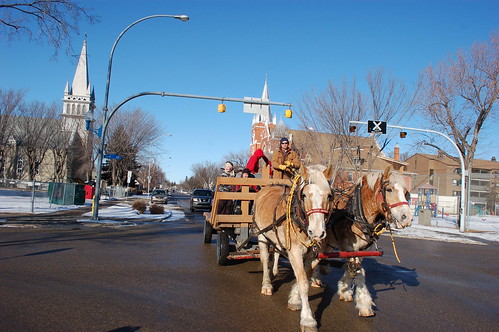
The horse-drawn wagon depicted above is winding its way through Church Street. To the left is Queen of Martyrs Vietnamese Catholic Church, and on the right is Sacred Heart Church of the First Peoples.

Church Street is one of Edmonton's most valuable historic resources. Although not officially called that - yet - Church Street is located along and around 96 Street in the McCauley neighbourhood, part of the inner city which is currently undergoing revitalization efforts.

Friends of Church Street is a new organization seeking to promote the historical significance of the area. It all started in the fall of 2010 when I was a Community Animator for McCauley with Action for Healthy Communities. Part of my job was to encourage and facilitate residents in grassroots community initiatives. One such initiative was the McCauley Connects Coffeehouse, which regularly features local talent.

The other initiative came from a woman named Colleen Chapman, who also happens to share Volunteer Coordinator duties with me at Boyle McCauley News. Church Street was in the process of being honoured by the Edmonton Historical Society and Colleen thought it would be great to have a Church Street Fair in the summer of 2011.

Planning an event of this magnitude proved to be too much for just a few months, so the event ended up getting pushed ahead to 2013. However, in the meantime, Colleen gathered together a group of community members and boosters to form Friends of Church Street. I am the Communications Director, and in addition to planning the Fair, we seek to raise awareness of and attention towards the history, architecture, and importance of Church Street.

The City of Edmonton is indeed taking notice of just how important the area is. This article, published in the February 27 issue of the Edmonton Journal, reveals that the City may very well make the name Church Street official.

Church Street is a boost to both McCauley's revitalization and the City in general. There is a rich history behind many of the churches, and the architecture is spectacular. In fact, Church Street has put Edmonton in the Guinness Book of World Records - 96 Street still holds the record for the highest concentration of churches within the few blocks it spans.

We launched our website today and are also on Facebook and Twitter (@ChurchStreet96).

What are some of your ideas concerning Church Street? Any suggestions for the fair? Walking tours? Souvenirs? Contact us and get involved!

Sunday, March 01, 2009

Monk Punks

Yesterday, I had the privilege of visiting Shawn and Kate's home. Actually, it is more than just a home - it is a community. It is a community for the group of people who live there in a co-operative living arrangement, and it is also a community of faith.

Shawn and Kate are originally from Lethbridge but moved to Edmonton a few months ago. They came here to reach out to the anarchist, punk, activist, and artist communities. Originally, the faith community bore the name "Monk Punks" reflecting the lifestyle of many of the people involved, but has since changed to "Look to the Cross for Victory."

Currently meeting on Saturdays, the community is associated with the Victory denomination. There were around 14 people there, mostly people under 30 bearing various kinds of piercings, tattoos, funky hairstyles, and leather clothing. It was next-generation and authentic.

The time there began with brunch (vegetarian breakfast burritos!) that several of the young women prepared. After cleaning up, we gathered in the living room for music. A guitar was being passed around, and eventually it found its way to me. I played the first half of "I Only Ask of God."

After a brief Bible verse meditation, Kate, Shawn's wife, put together a handmade songbook (a hymn 'zine, one could say). She led music, and has a beautiful voice. Music was followed by a time of sharing. One of the community members talked about judging others. It was a very appropriate topic since many of us have been judged in various situations because of our appearance or points of view.

We had some more music and prayer, and then Shawn gave me the ground tour of the home. There is a guest room, because the place is always receiving guests whom they can serve as Jesus served. Another room is a kind of art and journalling retreat. The walls are filled with expressions of art and faith. This is a place where creativity is highly values - even the calendars are hand drawn.

As I said before, the fellowship was genuine - these are people who truly have a heart after G-d. And like me, they are people who often walk between two worlds where people may not always share either their faith or ideas concerning social justice.