
After appearing to lay low for a while (although they were meeting on a regular basis), Occupy Edmonton decided to come out from the shadows and planned a "Re-Occupy Edmonton" march and rally. The event was originally to be held this coming weekend, but the organizers decided to move the date to February 1 to coincide with the National Student Day of Action protesting tuition fee hikes.
The plan was to march from Ezio Faraone Park to the University of Alberta campus, joining the U of A student protesters in Quad. However, plans were quickly changed. When I arrived at Ezio Faraone Park, I noticed a significant number of police officers, as well as an EPS chopper flying overhead. In short order, during a "mic check" (where one person speaks and everyone else repeats), it was explained that OE protesters could not set foot on campus. The U of A had asked the police to arrest protesters who did not heed this warning (never mind the fact that many protesters were current and former students and faculty).
At the same time, we were also told that Campus Security had issued a warning to U of A students on campus that they could not protest in the Quad area as planned. Both announcements were absolutely baffling to me, as International Week is currently happening on campus, the theme being Living Democracy: Citizen Power in a Global Age.
The march proceeded over the High Level Bridge and headed to Saskatchewan Drive, where police informed protesters they could not cross onto U of A property and made a human and bicycle barricade. There were around 20 police officers, another dozen or so Campus Security people, and that chopper flying overhead. There were around 70 protesters.
A lot of the focus shifted to the belief that Occupy Edmonton was going to set up an encampment on U of A property, thus leading to the campus engaging the services of the police. However, no one that I saw was carrying camping gear. Most of the people simply wanted to protest, and then leave. I don't understand why they were not allowed to do so. A university campus is supposed to be a place of free, open ideas and speech. If there were people who would have stayed behind and tried to camp - well, then that would have been the appropriate time for Campus Security to get involved, with police backup should it have been necessary.
And yes, students and staff with identification proving them as such were permitted to cross the street onto campus. Could they have protested on U of A property under these circumstances? We will never know.
But the major problem here is the shift of focus from the issue at hand - tuition fees and pay equity - to camping. Because of the police hoopla over Occupy Edmonton as an entity, the message got lost. I am not sure if this was a purposeful tactic by the U of A but if it was, it was a brilliant lesson in diversion.
Basically, the U of A completely overreacted. It shunned the value of free speech in favour of control. Historically, university campuses are places where radical politics take root and ideas from all spectrums flow. Instead, the U of A decided to let fear dictate its actions. Living democracy? This is not what democracy should look like.
Here is my full photo set from the protest. Here is a video of the initial mic check, when the news was shared concerning the police presence; the march to Saskatchewan Drive; and, the rally as it took place despite the police barricade.
I have been documenting the incident as portrayed in social media through Storify, and will continue to update the story as needed.
Wednesday, February 01, 2012
This Is Not What Democracy Looks Like - Occupy Edmonton, Part 2 & National Student Day of Action

Tuesday, November 22, 2011
Occupy Edmonton - Why We Should Care
I attended most of The Parkland Institute's Fall Conference over the weekend. The topic dealt with the economy and the growing divide in society between classes, as well as attacks upon workers and unions. Much of what was discussed was in the context of the Occupy movement.
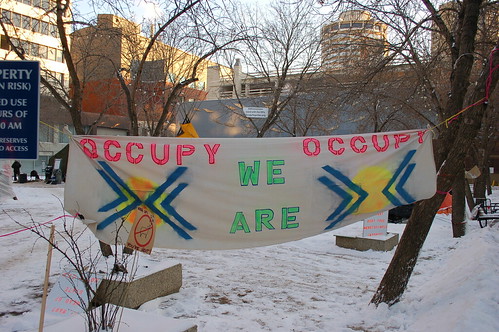
There could not be a more timely topic, as Occupy Edmonton has been holding strong for over a month now in the park owned by Melcor at 102 Street and Jasper Avenue. Despite a heavy snowfall and dramatically cold weather, a small group of campers have maintained at the site, having winterized (including putting up a military tent complete with a disco ball for entertainment shows).
Yet another deadline for eviction (I think this is the third) by Melcor has come and gone, with the Occupiers refusing to leave, offering up instead a list of demands.
This situation has brought about mixed reactions, even within the activist community itself. I met up with several long-time activists at the conference who felt that Occupy was a diversion from other, more pressing matters, like the dismantling of the Wheat Board. They also stated that Occupy doesn't seem to stand for anything, that its demands are not clear.
I respectfully disagree. First of all, it is just wonderful in general to see younger people standing up for something. At the various Occupy rallies and at the camp itself, I have met numerous people I have never seen before - and I have been kicking around the activist community for a good number of years now.
Secondly. if Occupy is accomplishing anything, it is raising awareness of the fact that the current economic system is not working as it should, in that corporations are getting breaks and exemptions that the common workers never gets. The rich get richer and the poor get poorer. That's the message I am getting.
I've also been hearing the arguments from a number of sides and political stripes that it is getting too cold to camp (so this is becoming a safety issue) and the fact that the group is on privately-owned land, and they should, in fact, occupy public land instead. These two issues (safety and private vs. public) are likely becoming the real diversions because Occupy is actually about more than just a camp itself.
Yes, safety is an issue, but these people are very passionate about spreading their message. And for those who say there is no message, I think the list of demands is pretty clear - lofty goals, yes, but clear nonetheless. As for the decision to be on privately owned land, I am going to go out on a limb here and suggest that Occupy Edmonton is making a statement that a corporation is not a person, as opposed to how said entities are treated legally and economically. However, if Occupy Edmonton does get evicted or chooses to leave that specific site, I know there is a Plan B (and C, and likely D).
Occupy is a global movement that will continue in one form or another. Maybe it will not change the world overnight, but there will be effects. We are witnessing one of the most important social movements of our time.
Wednesday, October 19, 2011
Occupy Edmonton - Reflections on a Movement
This past Saturday, Edmonton joined the growing number of cities around the world in the Occupy movement.
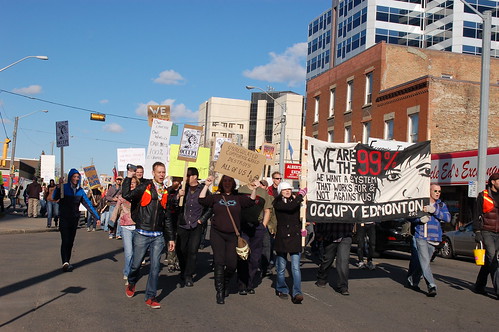
It all started on Wall Street in New York last month, when a grassroots group of individuals decided that they had enough of corporations getting tax breaks, bailouts, and other economic benefits not available to the average person, laden with taxes, debt, and other financial woes for which there are no subsidies or bailouts. The "occupation" involved camping out in the financial district of the city.
Soon, other groups of activists in other cities began doing something similar, in solidarity with the Wall Street campers, but also because this sort of economic unfairness happens all over. Corporations (and the people who run them) are only 1% of the population, while the other 99% pick up the slack.
October 15 was the Canadian day of action, and Edmonton saw at least 1500 people fill Churchill Square for a rally and march. Afterwards, around 50 or so people set up camp in a park on 102 Street and Jasper Avenue, where they remain as of the time I am writing this blog post.
The Occupy movement has taken a lot of criticism on two fronts: one, that is it is leaderless and two, that there is no clear agenda of what exactly people want. To address the first issue, a movement does not necessarily have to have a leader per se. A grassroots movement is exactly that - a group. Decisions can be made by consensus or in whatever way the group decides. The Edmonton model has been run via consensus.
As for the second, there are lots of things people tossed around as demands. Does a protest necessarily have to have one thing as a resolution? My summation, when asked, is that we need a more just economy that supports everyone, instead of putting corporate interests above all else. How that should come about - now, that is something that can have many different theories. There have been a number of general assemblies where the people involved in the camp discuss their strategies for effecting social change. I have not attended any of these, so I cannot comment further.
The same can be said of the peace movement, of which I am also a part. We all agree that war is wrong - how we achieve peace is where we have different ideas. We dialogue. It's all part of the process.
Occupy Edmonton is one of the largest rallies I have attended in around six years of attending, organizing, and participating in the activist scene. Obviously, a lot of people are concerned about the way our economy runs and it is not something to mock or ignore, whether or not solutions are immediately forthcoming.
In fact, I was recently asked about immediate, concrete results coming from a local protest. My answer is that the purpose of protests like marches and rallies is not to bring about immediate results. It is to raise awareness and to speak out. Again, this is all part of the process. It is a forum for expressing ideas and to educate others. People always ask me after events, even if they did not attend but see my photos and videos online, what the issues are. This brings the chance to educate. And then they tell me their perspective, and I learn from them.
There are always activists who get defensive when questioned about their motives, particularly because we have a tendency to get ridiculed for our actions and beliefs. It is unfortunately when lines of communication get muddied, but these experiences do not change the underlying reasons for the protest in the first place.
Whether or not Occupy Edmonton (or the Occupy movement in general) will have any long-term, lasting effects remains to be seen. However, it is a large-scale, bold example of free speech and democracy in action, and for that reason alone, should be encouraged.
To view my entire photo set from the march and rally, click here. For a video play list of all of the speakers and music, click here.
And a disclaimer: I was involved in some of the organizing of the Occupy Edmonton event on October 15 and sang at the rally.