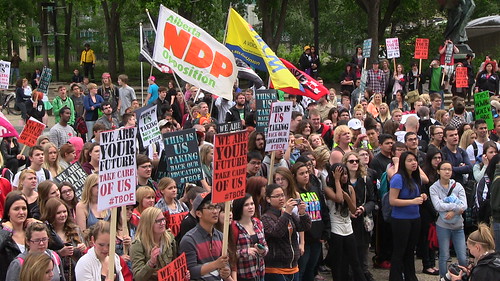
Last week, I attended a rally at the Alberta Legislature concerning cuts to education, organized by high school students. Taking Back Our Education saw students abruptly leave classes at 11 a.m., board buses, and head to the Legislature.
Aided by several unions, #TBOE (as it was also called) was a huge success. Hundreds of students and those in solidarity filled the area around the fountain. It was a moment where I could really feel my age. It was also a moment that caused me to reflect upon how I have ended up in life where I am now.
Many people know who I am and what I do, but don't know much about my background. I graduated from the University of Alberta with a B.Ed in Secondary Education (English major and Music minor). I wanted to become a junior high Language Arts teacher. Although I was already into writing and photography, and had actually been doing those things professionally as early as high school and throughout university, I viewed teaching as stable and something I could fall back on if my writing career did not pan out.
Well, there is an old Yiddish saying along the lines of "People make plans and God laughs." And I am sure the Almighty viewed this one as a gooder. I graduated in the mid-90s, in the midst of the Klein government's ravages to education. I, like numerous of my classmates, never made it into a classroom. There were simply no jobs to be had. Those who were lucky enough to find a job often lost it if they did not yet have their permanent contract.
Fifteen or so years later, the Conservative government is still in power and are responsible for more education cuts which will result in the loss of teaching jobs. I can empathize with those young teachers and those who are just graduating with their B.Ed degrees about the uncertainty of their futures.
On the silver lining side of things, those of you who appreciate what I do should thank the Conservative government for the fact I am the activist I have become. If I had landed a teaching job, I probably would not have the time to go out and document protests against all the incredibly destructive things this government has done. And the sheer number of rallies I attend are testament to the fact that this government does a lot of really destructive things.
Wanting to become a teacher should not be a pipe dream. Cutting teaching positions equates to larger classroom sizes, lack of personal attention to students with special needs, and just a lower quality of education overall. We apparently have a government that does not realize that its greatest asset is not actually the environmentally destructive tar sands. It is our future generations. Attending #TBOE gives me hope that a generation of voters (most of the students were in grade 12, so were 18 or almost 18) is coming up who will really be able to effect some tangible changes in the near future.
Showing posts with label province. Show all posts
Showing posts with label province. Show all posts
Wednesday, June 19, 2013
Taking Back Our Education

Sunday, February 26, 2012
Of Umbrellas and Safety Nets: Health Care in Acute and Chronic Crisis
This past Friday and Saturday, a conference called Beyond Acute Care had speakers and panels discussing health care issues concerning the elderly, disabled, and other vulnerable citizens. The illustration of what is currently happening our health care system is something like this: there is an umbrella over top of this population, which takes care of most acute needs. However, when the need for care becomes chronic, the umbrella gets smaller and smaller, with more and more services needing to be paid for out of the pockets of the patients or their families.
These issues are of importance to everyone, regardless of age or health status. Many of us, if we are fortunate, will become senior citizens some day. With the health care system being so precarious now, worrying about what it will be like decades from now is justified. As well, life can change in an instant. There are those for whom an accident, a brain injury, or a serious mental illness suddenly took them off of their current paths and into the chronic health care system. As well, if you are like me, you may become a caregiver to an ill parent, taking precious time from your work time and social life to attend to her needs while being faced with decisions concerning what to do when the situation becomes too medically complicated to deal with, without some outside form of help - help which will likely come with a price tag.
The "umbrella" of which the organizers of the conference speak has another name: the safety net. One with a lot of holes through which the vulnerable fall. For example, an elderly person falls, breaks her hip, and has to be hospitalized. Her acute needs are taken care of: she gets a hip replacement, some initial physical therapy, and during her hospital stay gets medication she needs for the pain. However, due to her injury, she can no longer live at home, unassisted. She either has to get live-in help or move to a long-term care facility - neither of which are inexpensive options. Plus, she has prescription medications that, while subsidized because of her age, still cost a significant amount out of pocket for someone on a fixed income.
So really, when a medical situation goes beyond the need for acute care, things get quite precarious. Even within acute care, a person's finances can be stretched. Prescription medication is perhaps the best example of this. I had an ear infection requiring antibiotic drops a few years ago. The tiny bottle of medicine cost around $35. That is a lot of money for someone on a budget. People who have chronic conditions like MS have medication they have to be on for the long haul. Unless they have good private insurance from their employer (which is getting rarer and rarer these days) or have purchased insurance on their own, they are financially hooped.
Related to this are the ridiculous fees one has to pay to see a dentist, which is also not covered unless you have private coverage. Last year, I had to have two fillings, a check up, and a cleaning. The bill came out close to $1000. I don't have insurance, so the bill caused me quite a bit more pain than my cavities. It was also a reminder as to why I had not been to a dentist for five years. However, infections and abscesses originating in the mouth can lead to death. I can't understand why dental work is not covered by our health care system. Since we're talking about older people, they often need extra dental care and procedures like having dentures made for them.
Another issue affecting our health care system is the pay and treatment of Alberta Health Services Support Workers. The wildcat strike held by members of the AUPE at the Royal Alex and University of Alberta hospitals on February 16 was a wakeup call to many to these workers' conditions. Perhaps it is my OCD tendencies speaking, but I want the person responsible for sterilizing equipment for a procedure to be well-treated and well-paid. The very fact that over 60 elective surgeries had to be cancelled demonstrated the importance of these people to the proper functioning of the health care system. Respect them.
It is a government's job to make sure its citizens are healthy and protected. There is a provincial election around the corner. Pay close attention to what the candidates are saying about public health care. If anyone even breathes the word "privatization" - be afraid. Be very afraid. Because no matter how much they promise that the system will be arranged in such a way that everyone will have access, regardless of their financial situation, invariably it will turn into a situation where those who can pay will get treated first, and better. Instead, choose those who will make our public services a priority and put money where it is needed. After all, like closing speaker Maude Barlow (National Chairperson of the
Subscribe to:
Comments (Atom)