Showing posts with label daughters day. Show all posts

Sunday, October 19, 2014

Together, Creating a Better World: Workshop Notes

Together, Creating a Better World - Workshop

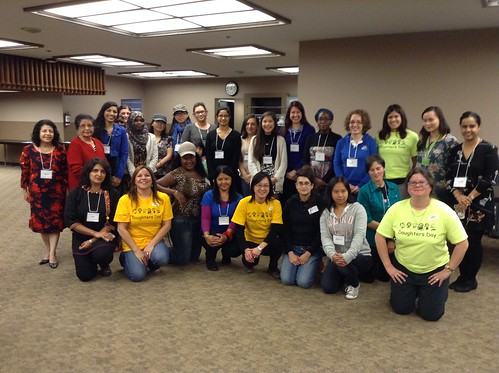
Together, Creating a Better World is the title of a handbook (written by long-time activist Jim Gurnett) and more recently, a workshop aimed at women who are new to community organizing. The event was organized by the same group responsible for Daughters Day and took place on October 18 at the Stanley A. Milner branch of the Edmonton Public Library. Four women presented about different aspects of community organizing to close to 30 women from a variety of backgrounds. First, we heard about identifying a social issue and analyzing it. The next presenter spoke about mobilizing the community around a social issue. Then, we learned about organizing a good event on a social issue. I was the final presenter, and spoke about communications: how to effectively get the word out about an event or working group on a particular cause, and documenting events, with an emphasis on the use of social media. Below are my notes from the session, with the hope they will be of value to women and basically anyone who is new to activism and using the technology that is available to organize, promote, and document citizen engagement.


Introduction
About me:
  • Freelance communications professional who works in traditional and new media.
  • Activist, organizer in peace movement. With Edmonton Coalition Against War & Racism (ECAWAR).
  • For almost a decade been documenting the local activist community at RadicalCitizenMedia.com
  • Connect with me on Facebook (search my name - personal and music page); Twitter.

    Why Social Media?
  • Traditional media still has its place: letters to the editor can be effective as well as placing free notices in listings in newspapers.
  • Social media more far-reaching to inform, document, and express concerning issues of social justice.
  • Benefits: Free (or low-cost); low learning curve; relatively simple.
  • Barriers: Not everyone can afford to have access to a computer or smartphone. Can be a classist issue. Not everyone is on social media - can be a generational thing where people are not as used to using a cell phone or computer. Lanaguge if English is not your first language.
  • Solutions: Libraries and some organizations have computers that are free to use. Even homeless people can sign up for an email account. You can post in your native language and reach people in your culture that way. Otherwise, your English does not have to be perfect and there is the opportunity to improve English by using it online.
  • Concerns: Privacy issues: don't post anything you would not feel comfortable with the whole world knowing. Don't post very personal details online. Corporate data mining - the price to pay for using a free service.
  • Smartphones can equal safety in activism: If something goes wrong, someone can photograph or film, and send to social media in real time.

    Integrated Use
  • Overview of the use of Facebook, Twitter, Flickr, YouTube, Instagram
  • Hashtags: mark Tweets to make searches specific, eg. #yeg for Edmonton. Create a hashtag for your event, eg. #DD2014yeg for Daughters Day 2014.
  • Facebook events: invite friends, get them to invite friends, etc.
  • Free blogging sites: Wordpress, Blogger
  • RadicalCitizenMedia.com: links up photos and videos into a blog.
  • Post links to photo albums, events on Twitter.
  • You might want to have a communications subcommittee where someone photographs, and other films, another posts online, due to workload.

    Success Stories
  • Occupy, Idle No More, and recent Palestine solidarity
  • Social media is becoming more accessible and commonly used.
  • Specific social media campaigns, like taking a selfie holding a sign with a message, and posting on Facebook or Twitter.

    Discussion
  • How many of you are familiar with Twitter and Facebook?
  • Have you ever used social media to organize? If so, for what?
  • What concerns do you have about using social media?

    Questions
    This portion of the workshop was open to questions. Here are some of my comments in response to the excellent questions I was asked:
  • Documenting events can be beneficial if you seek future funding, as you have proof of your previous event and also provide the opportunity for sponsors to be recognized through your photos, etc.
  • If you are photographing a public event in a public space, you don't need direct consent from everyone in attendance to take pictures and post them. You can announce, as a courtesy, that you are filming/photographing and say if anyone has a problem with appearing in photos to let you know. Disclaimer: This is not legal advice. This is from my own experience and what I know of these situations.
  • Saturday, September 08, 2012

    Feminism and Paradigm Shifts

    I recently helped organize an event called Daughters Day, the purpose of which was to celebrate the lives and achievements of girls and young women, while raising awareness of human rights abuses against them.

    One of the comments I met again and again was that, in order for a better quality of life and equality for all girls and young women to be achieved, there needs to be a paradigm shift in society. We can decry human rights abuses and lack of equality all we want, but unless there is systemic change, things will remain the same.

    These comments seem vague. Digging deeper, here are the two major issues that need to be addressed by society as a whole to make things better for one half of it.

    Attitudes of Men

    Early on, a woman leader in the Aboriginal community emphasized the need for men to take a stand on issues pertaining to women's rights. In Edmonton, there are two major walks for missing and murdered Aboriginal women - both organized by women. Both featuring mostly women speakers. In fact, most protests and rallies dealing with women's issues feature a program of women.

    This is why the organizers of Daughters Day specifically asked a male Aboriginal activist to be a speaker (Lewis Cardinal), about being a role model and the need for men to speak up.

    We were very encouraged that so many men attended Daughters Day and brought their daughters - and sons - with them. A question I was personally asked frequently in interviews was if boys and young men would have anything to gain from Daughters Day. I said yes - part of the mission of Daughters Day is education and hopefully we are contributing towards raising a next generation of men who will be more enlightened and in a better position to stand up for their sisters, aunts, cousins, mothers - and, of course, their own daughters, eventually.

    Popular Culture

    Popular culture has always been a woman's worst enemy. From airbrushed photos to models who are painfully thin, girls internalize an impossible (and unrealistic) standard of beauty from a young age.

    Exposure to media that glorifies feminine weakness and abuse is also a rampant problem. Look at what movie and book series is very popular with "tweens" right now: Twilight. At the centre of the story is a relationship between a female human and male vampire that is physically and emotionally abusive on a number of levels. I have to admit I have not read any of the books, but I have seen all of the movies thus far (don't judge me).

    Why do so many young women think that this is okay? For some, it started when boys started teasing or hitting them. When they complained to an adult they were told that boys acted that way when they "like" a girl. I know - this was told to me numerous times. Later on, when a man is ignoring or stalking or yelling at or hitting a woman, it is just seen as an extension of that childish behaviour. Adults should never condone bullying in any way, especially when boys are picking on girls, because of how this can set the tone for the rest of life.

    Just look at all of the women falling head over heels for the fictional character of Christian Grey in the best-selling novel 50 Shades of Grey. I am currently reading it (don't judge me - okay, judge me) and besides the atrocious writing and plot that is barely beyond pornography (and badly written porn, at that), is the character of a woman who abandons her morals, values, and seemingly her brain just because she meets someone who is "ridiculously" good looking (and well-endowed, as she learns later).

    I'll tell you what is ridiculous - the fact that so many grown women are joining in the swooning. Swooning over a man with a broken character who takes advantage of a woman simply because he knows how to charm her - well, this is buying into the old stereotype that women care about looks and money (Christian's wealth is mentioned ad nauseum - which is a good description of how I often feel after reading the detailed sexual exploits described in the novel).

    If this is the kind of literature (and I use that term loosely) we women glorify, we really have not come far at all. I challenge women who enjoy 50 Shades of Grey to read something - anything - that features strong girls and women. Books like Anne of Green Gables, Little Women, and anything by Jane Austen should be required reading in schools. Personally, I'd love to see a novel featuring a hot, sexual relationship that is between two people who are equals - and which is not pornographic. Anyone have any suggestions?

    In Conclusion

    Women will move closer towards equality when society experiences paradigm shifts in terms of how men treat and stand up for us, as well as how popular culture portrays us. We have a role to play in helping to educate our brothers while not glorifying media that continues to expound bad stereotypes and glorify abuse as romance or eroticism.
    Friday, September 07, 2012

    Daughters Day Celebrates and Makes History

    Daughters Day

    On September 1, history was made in Edmonton.

    The first ever Daughters Day took place in Churchill Square. Organized by a grassroots group of community members from different cultures and walks of life, Daughters Day was in the making for over a year. Its purpose is to celebrate the lives and achievements of girls and young women, while raising awareness of human rights abuses against them. The idea actually materialized amongst some older men in the Indo-Canadian community, and it was not hard to get support from other groups and organizations.

    Almost an entirely volunteer effort, we met regularly to plan the event, as well as two community engagement sessions leading up to it. The first took place on March 8 (International Women's Day) and had an Aboriginal theme. The Carrot Community Coffeehouse was packed to listen to Phyllis Sinclair sing, and then get advice about life from a session of "Ask Your Auntie."

    The second was closer to Mother's Day. "Rebuilding Lives" featured a panel of immigrant women discussing their experiences, moderated by Global's Lesley MacDonald, as well as a main talk from REACH Edmonton's Jan Fox. Held at NorQuest, it was also well-attended.

    However, September 1 was the main event. We got a lot of buzz from the media in the two weeks leading up to it. Two days before that Saturday, we got word that Premier Redford would be attending with her daughter Sarah. This shot the buzz to an entirely new level. Over 400 people attended the event, we got lots of media coverage, and lots of positive feedback.

    What happened? Well, greetings were brought from the different levels of government and organizations like the EPS and RCMP. Four women were awarded as "Daughters of the Year," including our keynote speaker, Karina Pillay-Kinnee, the mayor of Slave Lake. There were performances of dance, drama, and music. I had the privilege of performing the official Daughters Day theme song I wrote especially for the event.

    Daughters Day is important to anyone who is or has a daughter. All women, regardless of who we are or how old are are, are someone's daughter. We need to keep striving for equality and human rights, especially now in current events where women are being told by men how and why their bodies work - something very "akin" to ignorance. The organizing committee is currently reviewing the event and making decisions about where to go from here. To learn more about our future plans, join our Facebook page, follow us on Twitter or keep checking back at our website, which is going to be revamped in the near future.